

Gwadar
The geopolitical signals that investors miss about Pakistan's mineral and maritime potential

I stood at the edge of Gwadar Port’s container terminal watching a lone crane move against an empty horizon. The port can handle 300 million tons annually. That afternoon, it sat mostly idle. The gap between what this place could be and what it’s allowed to become felt deliberate.
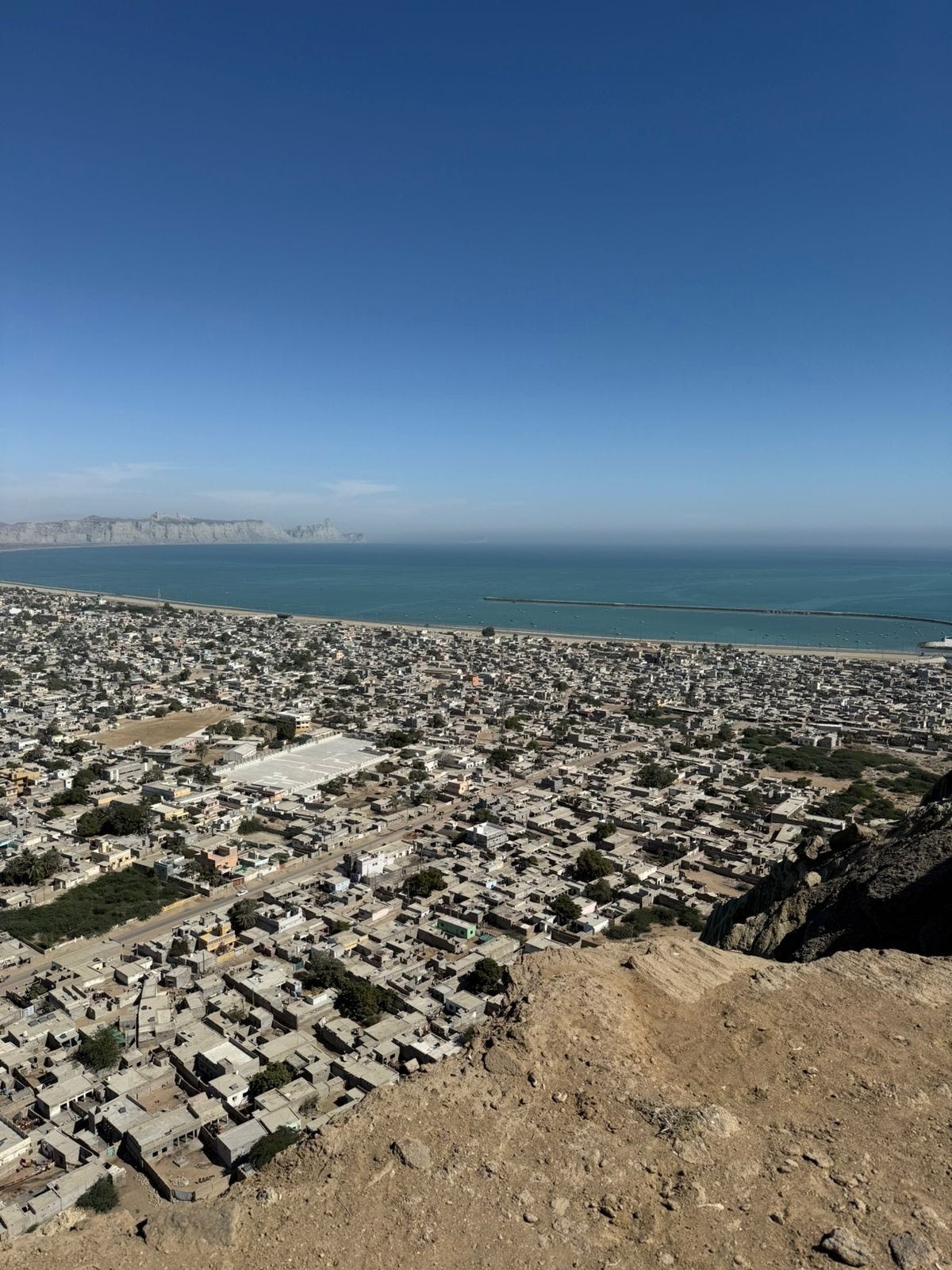
During Pakistan’s National Security Workshop, a senior official described Gwadar as “the most expensive monument to unrealized potential in the region.” Later, over tea in Quetta, a mining executive put it sharper: “Every time we get close to moving dirt at scale, something blows up. And it’s never random what blows up.”
The question I kept returning to: what if Balochistan’s instability isn’t a bug in the system? What if it’s a feature someone else designed?
I wrote about Pakistan’s chance to climb the mineral value chain in The Nation last week. But the bigger story sits underneath. Balochistan’s stability directly threatens established regional infrastructure monopolies, particularly Gulf transshipment routes and port networks. When a corridor cuts transport times by 40 percent, when a port offers China direct Arabian Sea access that bypasses the Malacca Strait, when mineral processing moves onshore and captures margin that currently flows elsewhere, the rational move for competitors is to keep that threat unrealized.
For investors, this means the violence isn’t random. It’s strategic. And it should be priced differently.
Private equity funds and infrastructure capital treat Balochistan as generic emerging market political risk. They’re missing that this is contested supply chain infrastructure in a zero-sum regional competition.
Three signals investors treat as noise.
Signal one: The rhythm of violence
In 2025 alone, Balochistan registered hundreds of attacks. The ongoing wave dubbed “Operation Herof 2.0” hit multiple locations in carefully choreographed strikes.
Track the dates: major attacks coincide with CPEC Phase II mineral announcements, the Pakistan Minerals Investment Forum, and a short while after the National Minerals Harmonisation Framework 2025 is announced.
Each time Pakistan and China publicly reposition their partnership around mineral-led industrialization, infrastructure gets hit. For global capital, each attack reads as confirmation of generic risk. When US interest rates rise and fund managers see news footage of burning checkpoints, they close the file and move to the next opportunity. The attacks happen too consistently, and too close to major announcements, to be random.
Signal two: The targeting pattern
Baloch insurgent groups explicitly frame CPEC, Reko Diq, and related projects as “plunder.” They’ve shifted from hitting purely military targets to sabotaging the logistics spine itself: roads, rail, and the perception of safety around port cities. There’s no ideology at play here. It's a strategy to make the infrastructure unworkable. Beijing’s frustration after repeated attacks on its nationals has translated into open demands for stronger security arrangements for Chinese assets under CPEC 2.0. The insurgent attacks create conditions that make Chinese security overreach more likely, which validates the insurgent narrative of “occupation,” which fuels more violence. It’s a self-reinforcing loop. Someone wants it to keep spinning.
Signal three: The regional incentive structure
Jebel Ali in Dubai handles 15 million containers a year and dominates shipping in the Arabian Sea. A working Gwadar port would cut thousands of kilometers off China's western trade routes and sit closer to the Strait of Hormuz. For Dubai's port operators, that's a direct threat to revenue. Pakistani and regional media have reported that UAE-linked interests benefit when Gwadar stays dysfunctional. At the same time, those same interests are expanding their stakes in Pakistan's other ports. The math is simple: every year Gwadar stays too dangerous to use is another year Jebel Ali keeps its monopoly.
The investor blindspot
In Chile or Indonesia, investors ask about tax rates and environmental regulations. In Pakistan, they ask: Can the military protect our sites? Who controls the roads at night? Does having Chinese partners make us safer or paint a target on our back?
An investor who wanted to setup a gold processing refinery told me they’d walked away from a Balochistan minerals deal because “they couldn’t explain burning convoys to our LP committee.” In other words, the risks were too high. Fair enough. But the reaction misses the point.
Investors see Balochistan as "too risky" when they should see it as "strategically contested." The violence isn't about whether there's demand for copper or whether the geology is good. It's about who controls the corridor that moves the copper to market. And corridor risk can be priced and structured if you know whose corridor you're threatening.
The call
Within 18 to 24 months, any billion dollar copper, gold, or rare earths deal that uses Gwadar as its export route will need two things: a formal security arrangement for the transport corridor, and either political risk insurance or a guaranteed buyer from a major government. That’s not a reason to walk away. It’s table stakes for entry into one of the last large, undeveloped minerals regions left.
For investors, the choice is simple: treat the friction as a dealbreaker, or treat it as the discount it actually is. The opportunity exists. It won’t wait forever.