

Why Governments Must Learn to Think
A structural analysis of institutional memory and the cognitive architecture governments need to survive

The memory problem
Governments that cannot learn will not survive. This isn't hyperbole. It's the reality facing institutions globally, particularly in fragile states where they operate without memory or learning capacity.
In my work with and analysis of government systems, I've seen the same pattern repeat:
Institutions designed for the 20th century trying to solve 21st century problems with 19th century thinking.
The pattern is predictable too:
Decisions made with limited data, past failures ignored, no mechanisms to adapt.
The result? Repetitive policy cycles, failed interventions, and administrative paralysis disguised as reform.
But here's what I've learned after examining dozens of these failures:
The fundamental crisis isn't corruption or inefficiency. It's that governments mistake storage for sense-making.
Filing documents ≠ remembering
Digitizing records ≠ understanding
Collecting data ≠ learning
They build filing cabinets when they need a brain.
I call this the memory decay spiral. Each time a bureaucracy reshuffles, forgetting begins. The same ideas are repackaged under new slogans. They fail again. Citizens lose trust. The cycle resets.
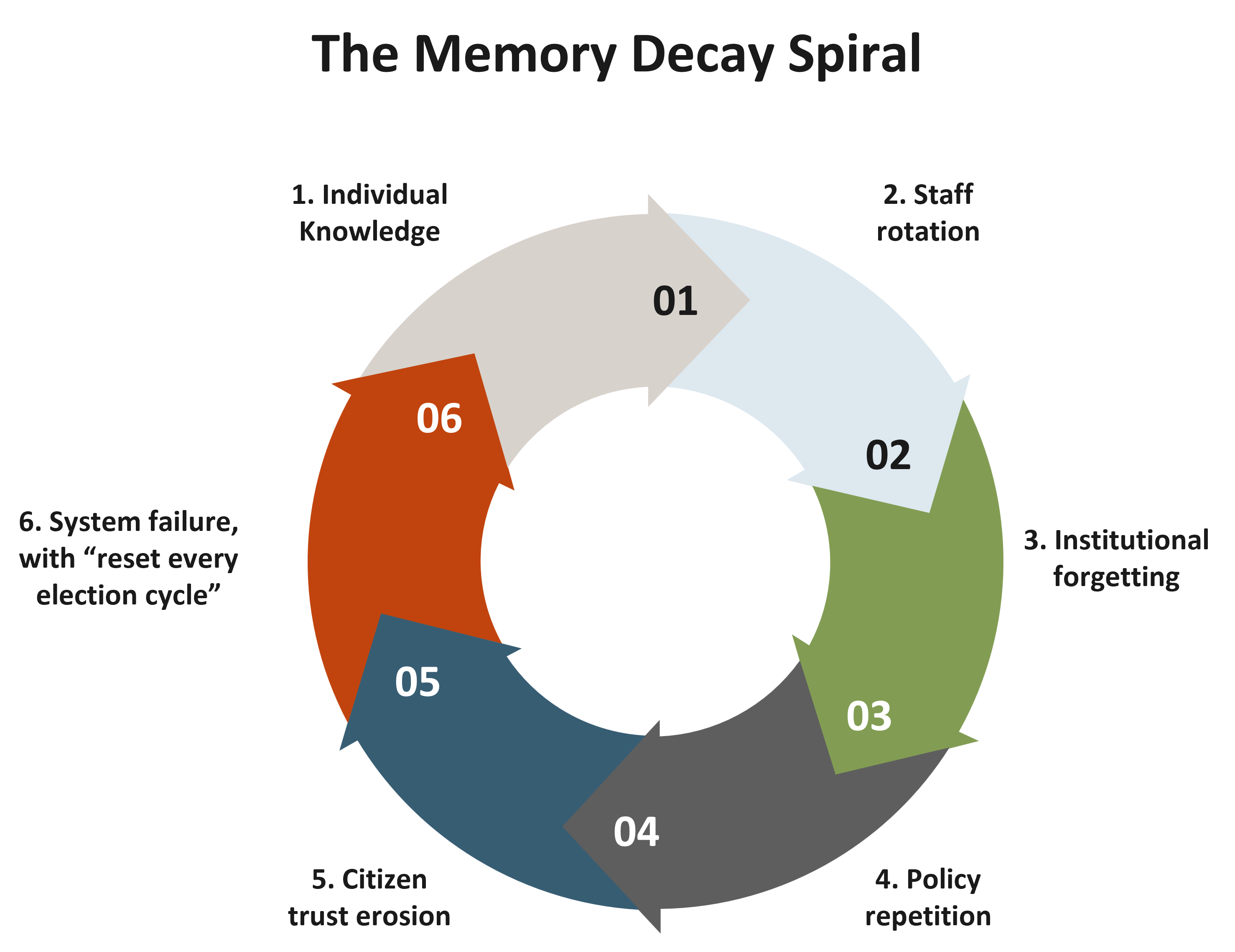
These aren't isolated cases of poor execution. They’re symptoms of a deeper design flaw: public systems optimized for repetition, not reflection.
How do governments react to solve this problem?
They digitize.
Why digitization keeps failing?
Most reform attempts at improving government efficiency and effectiveness focus on digitization, treating government intelligence as a data management problem. Multilateral institutions promote GovTech as the solution, spending billions on digital platforms and mobile apps. Yet this consistently fails in government contexts.
Consider the evidence I've tracked across multiple contexts:
Pakistan: Seven attempts at land record digitization since 2007, each with new software and donor funding, each producing identical failures. The country’s federal level digitization effort, for example, allocated PKR 500 million to modernize 34 departments. Only 7 of 171 planned modules were developed, none implemented effectively. The Citizen Portal which was designed to receive and address complaints is now a log of inefficiencies rather than a resolution mechanism. These are just some of the many reform efforts that failed because the solution was being looked for in the wrong place.

Kenya: Identified tens of thousands of ghost workers twice, yet the same systemic problems persist.
Afghanistan: Donor-funded digital infrastructure vanished when the regime collapsed, leaving no institutional memory.
Tanzania: $60 million e-government program failed to achieve meaningful adoption.
Malawi: Digital tax reforms stalled due to internal sabotage and data manipulation.
South Africa: e-ID and social service platforms underperformed due to planning gaps.
The reason is structural:
Digitizing broken processes produces expensive digital dysfunction.
Digital systems assume:
Clean data
Institutional stability,
Rational behavior
But in fragile contexts, you get:
Elite capture
Parallel power structures
Constant political churn
And so digitization fails.
The point of failure can be located through a Storage vs. Intelligence Matrix:
Government digitization efforts focus on quadrants 1 and 2. The real breakthrough requires moving from quadrant 2 to quadrants 3 and 4.
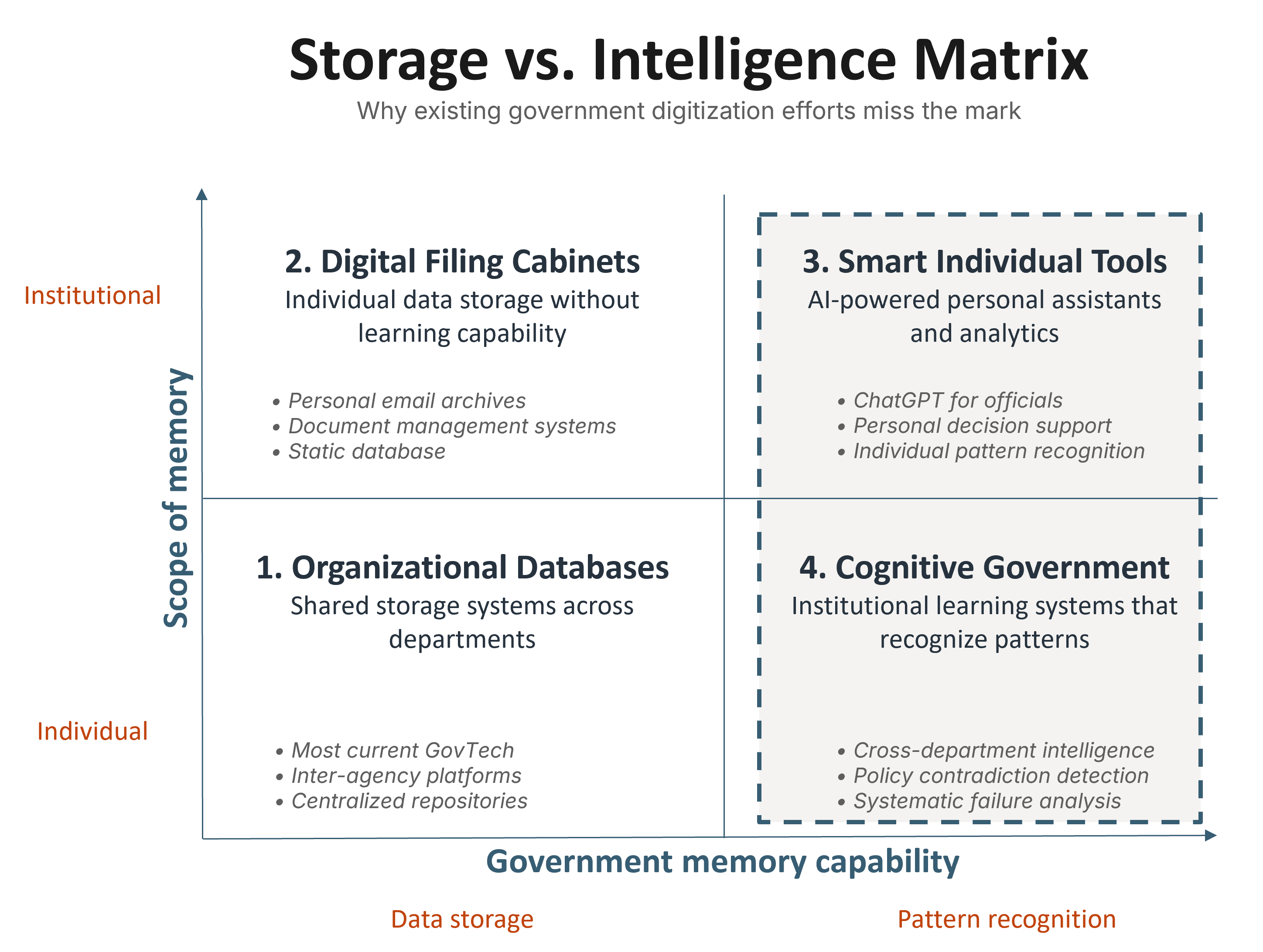
We need to stop thinking in terms of systems that store data and start building systems that learn.
The cognitive architecture solution
In short, governments need a cognitive architecture. The cognitive architecture layer sits above traditional GovTech efforts. It is neither another app, nor a platform. It’s a redesign of how institutions process information, make decisions, and learn from outcomes. It creates governance systems capable of using the massive data that sits in digital storage or filing cabinets to challenge assumptions and revise approaches. And this is how I envision it:
Layer 1: Memory Systems
Recognize patterns in failure
Preserve context and constraints
Connect decisions to outcomes
Layer 2: Processing Systems
Detect contradictions between policies in real time
Model outcomes before implementation
Surface insights across ministries
Layer 3: Adaptation Systems
Update rules based on real-world feedback
Make mid-course corrections normal
Share what works across departments
Implementation considerations
AI offers the technical foundation for building these cognitive capabilities at scale.
To illustrate how cognitive architecture layer could be implemented, let’s take a hypothetical example based in Pakistan. The federal government is under pressure to stabilize electricity prices. To relieve short-term political pressure, it announces across-the-board energy subsidies for consumers and industries.
Meanwhile, the Ministry of Finance negotiates an IMF agreement that requires reducing fiscal deficits, including slashing energy subsidies.
At the same time, the Ministry of Climate Change launches a clean energy roadmap tied to international climate financing, which requires reducing reliance on fossil fuel based power plants, many of which are kept afloat by those same subsidies.
Three policies. One government. All in conflict.
Now let’s see how this three-layer cognitive architecture could prevent the breakdown
Layer 1: Department Execution Agents
AI agents inside each federal ministry track internal activities and report key signals:
Power Division agent logs increased subsidies, rising circular debt, and capacity payments to fossil fuel plants.
Finance Division agent flags the fiscal pressure and identifies the IMF performance benchmarks.
Climate Change agent maps inconsistencies between power policy and Pakistan’s Nationally Determined Contributions (NDCs).
Each agent works silently in the background, surfacing what's happening—not just what’s been announced.
Layer 2: Domain Monitoring Agents
These agents work across ministries to detect contradictions and opportunity costs.
Energy-Finance conflict detector identifies that rising subsidies violate IMF benchmarks, risking loan delays.
Climate-Energy misalignment monitor notes that fossil-fuel subsidies conflict with clean energy targets and international green financing requirements.
Debt risk monitor calculates how energy policy decisions are driving the circular debt spiral above sustainable thresholds.
These contradictions are flagged, contextualized and quantified.
Layer 3: Central Synthesis System
This layer connects the dots.
A strategic trade-off engine simulates policy scenarios: maintaining subsidies vs. protecting fiscal space vs. enabling green financing.
A meta-coherence agent generates policy suggestions that align power pricing, fiscal discipline, and climate goals.
The system proposes a targeted subsidy redesign which protects low-income households while phasing out industrial subsidies and links it to green financing conditionalities.
This solution is then routed back to ministries for implementation, along with a memory log: what was tried before, why it failed, and how this version is different.
In this example, cognitive architecture doesn’t just help balance priorities. It helps preempt contradictions, preserve institutional knowledge, and sustain policy alignment across administrations.
It’s a shift from policy fire-fighting to systemic coherence which is what fragile federations like Pakistan need.
The guardrails we need
Developing such systems requires strict democratic safeguards. Without proper oversight, AI-powered government intelligence risks authoritarian overreach or systematic suppression of dissent.
Pakistan, and countries like it, cannot afford another opaque system of control. If we’re building a government’s memory and cognition, we must also build transparency, auditability, and public trust into the system from day one.
This would entail strong AI governance practices, complying with international standards, and adhering to the following at the foundational level:
AI-generated insights must be public and explainable. Not just outcomes, but reasoning. When subsidies are flagged as contradictory, the “why” must be accessible to decision-makers, journalists, and citizens alike.
Human decision-makers stay in the loop. Always. Systems advise, not dictate. Elected officials remain accountable for final calls.
Citizen input becomes a feature, not a bug. Feedback channels allow people to challenge incorrect inferences, submit local knowledge, or flag blind spots.
Independent oversight bodies conduct regular audits. Legal, ethical, and bias reviews are mandatory by design. There is no room to conduct them ex-post a scandal or debacle.
Cybersecurity shouldn’t be an afterthought. This layer becomes a national security asset and we’re not just protecting databases, but institutions. Protecting their integrity means strict access control, red-teaming, and continuous monitoring.
Guardrails are what will make the long-term legitimacy of such systems possible.
A better way to govern
Introducing a cognitive architecture isn’t about automating governance. It is about increasing its effectiveness and efficiency. It’s about augmenting public judgment so that future decisions are better, faster, and less fragile.
It’s a massive design opportunity.
Final thought
Some forgetting is useful. It clears the path for renewal. But when governments forget everything they have stored, which they do frequently, they don’t start fresh. They start over.
The result?
New platforms.
New slogans.
Same outcomes.
The challenge ahead is clear:
Stop organizing around dysfunction.
Start building memory systems that can actually learn.
Coming up next:
I’ll break down each of the three layers (Memory, Processing, and Adaptation) in a dedicated post soon.
If this resonated, follow along.