

The Fault in Our Stars
Is the Muslim World responsible for fueling the zionist war machine? And how that war reaches Pakistan.

Almost half of the oil that keeps Israel’s economy and its army moving comes from a Muslim country. In 2025, Azerbaijan supplied 46.4 percent of Israel’s crude, a three-year high, pumped through the Baku-Tbilisi-Ceyhan pipeline to a Turkish port and shipped onward to Israeli tanks.
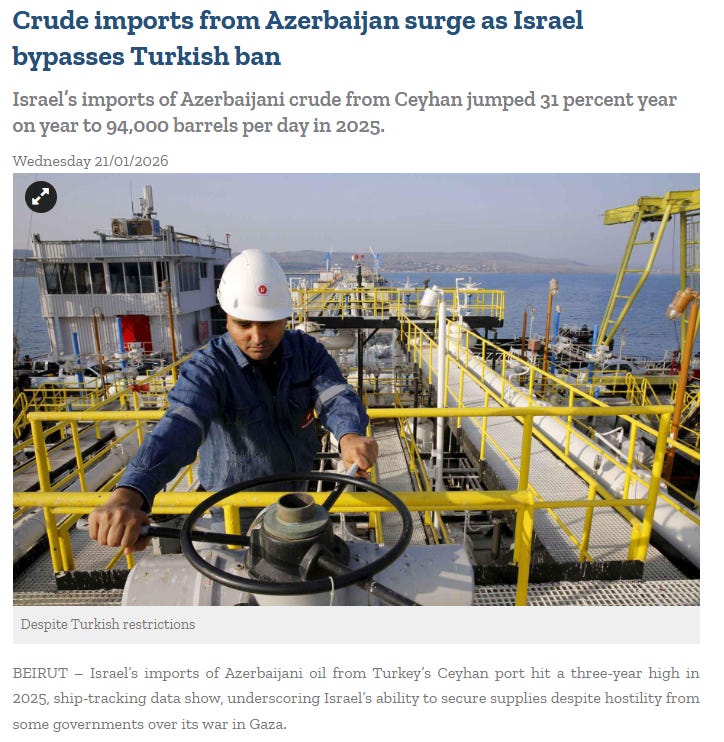
Turkey announced a total trade ban on Israel in 2024. The oil still flows through its waters. So does the steel that feeds Israel’s weapons plants. This is the uncomfortable place to start, because the loudest voices against the war in Gaza belong to the same governments whose ports, pipelines, and defence deals help keep it running.
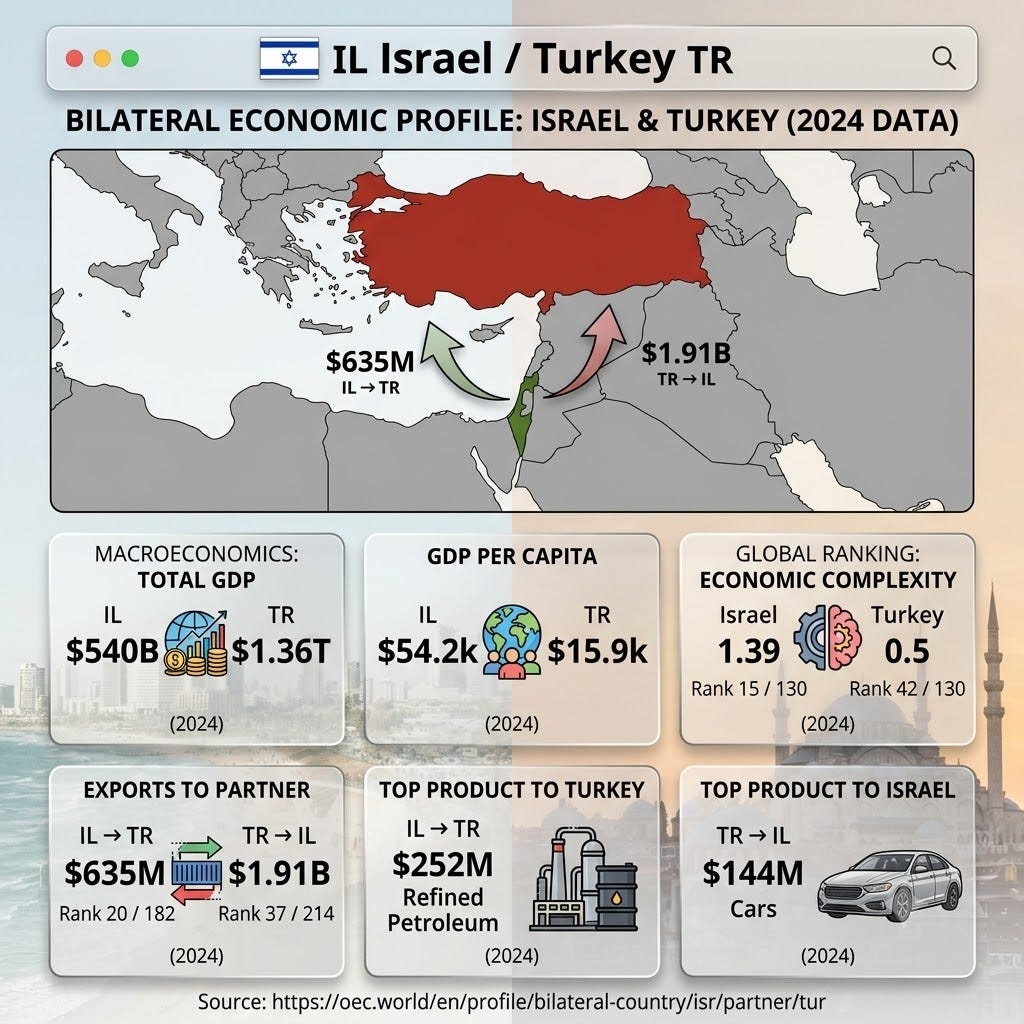
That gap between what Muslim states say and what they ship is the story. And it runs straight into Pakistan, which sits at the far end of the same chain, paying for a war it did not start and cannot stop.
What the Trade Data Actually Shows
Start with the numbers, because they are harder to argue with than speeches.
Israel’s crude imports from Azerbaijan rose 31 percent year on year in 2025 to 94,000 barrels a day. In return, Israel is Azerbaijan’s main arms supplier, the source of the drones and missiles that decided Baku’s 2020 war with Armenia. Oil goes one way, weapons go the other, and a shared fear of Iran holds the arrangement together. Turkey sits in the middle and collects the transit fees.
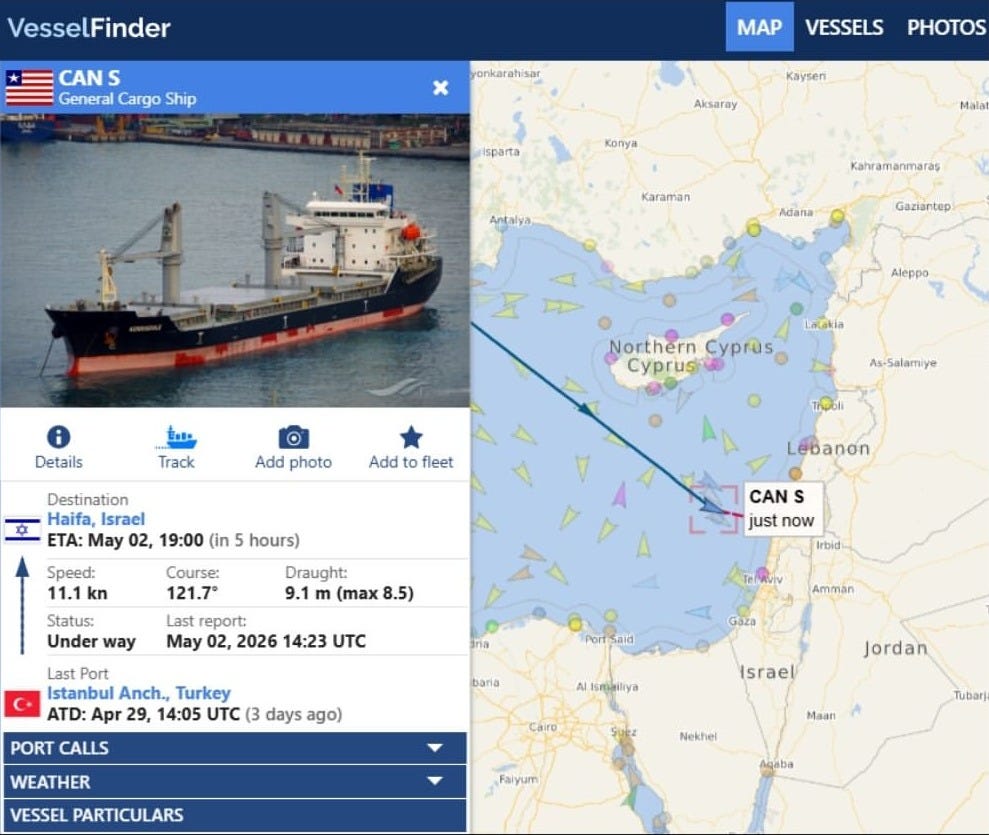
Turkey’s own conduct is the sharpest example of the double game. After Ankara declared its trade halt in 2024, tankers loading Azeri crude at Ceyhan kept turning off their tracking systems, signaling false destinations before quietly discharging at Israeli ports. Industrial goods took a quieter route. Turkish exporters relabeled shipments for the “State of Palestine,” routing them through West Bank markers where selected firms took a small commission to keep the paperwork clean. Exports to Palestine jumped more than elevenfold in a single month in mid-2024. Under that cover, Israel bought $171.1 million worth of Turkish iron and steel between January and September 2025, the same steel that has long made up the bulk of its arms-industry feedstock. Add roughly $868,000 in weapons and $877,000 in explosives over two years of war, more than half of the explosives arriving after the ban.
None of this is fringe activity. An Al Jazeera analysis of Israeli customs records found military-related goods from at least 51 countries kept entering Israel after the International Court of Justice warned in January 2024 of a plausible risk of genocide. Imports rose after that warning rather than falling.
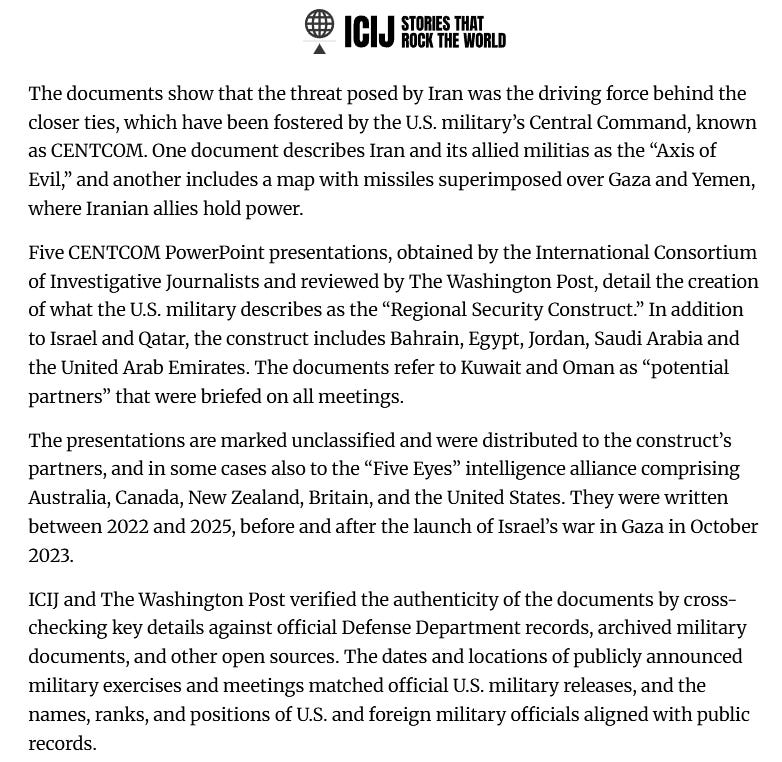
Then there is the part that happens away from the cameras. Leaked United States Central Command documents, verified by the International Consortium of Investigative Journalists, show a “Regional Security Construct” running from 2022 to 2025. Under it, military officers from Bahrain, Egypt, Jordan, Qatar, Saudi Arabia, and the United Arab Emirates sat in confidential planning sessions with Israeli commanders, linked their radars into a shared air-defence picture, and trained together on how to find and destroy tunnels.
The same governments that called the Gaza war a genocide at the United Nations were, at the officer level, quietly coordinating with the army carrying it out.
That is the first insight, and it is a small one only in the sense that it is rarely stated plainly. The war machine is not purely Western. It runs on Muslim oil, Muslim ports, and Muslim security cooperation, bought and sold by governments whose public position is the opposite of their trade data.
The Petrodollar Loop That Pays for the Bombs
Widen the frame and a pattern appears that is larger than any single shipment.
Gulf states are among the biggest buyers of American weapons on earth. Those petrodollar purchases fund the United States defence industry, which is the same industry that arms Israel. A recent $2 billion package to Saudi Arabia is one line in a long ledger. Some of the buying is direct: in 2018, Saudi Arabia reportedly bought more than $250 million in Israeli surveillance equipment through a United States-brokered deal, complete with training. The UAE contracted Israeli spyware. Money leaves the Gulf, weapons flow back, and the machine keeps turning.
The engine underneath it is oil sold through the Strait of Hormuz. Gulf carbon exports keep the global grid running, the revenue buys Western and Israeli hardware, and that hardware secures a regional order built to contain Iran. Energy out, dollars in, weapons back. The loop does not need anyone to believe in it. It only needs the shipments to keep moving, and they do.
This is the second insight, and it is heavier than the first. Individual sales can be explained away. The loop cannot. It is a structure, and structures outlast the outrage of any single week.
The Western Border: Where the War Reaches Pakistan
Here the chain closes on Pakistan, and here the argument turns from trade to strategy.
Pakistan spent the spring of 2026 doing something no one expected. It brokered talks between the United States and Iran, seated two enemies at one table for the first time in four decades, and put its prime minister’s signature on the June 17 Islamabad Memorandum of Understanding.
For a moment, a nuclear-armed Muslim state that has never recognised Israel became the region’s indispensable go-between, linking Washington, Tehran, Riyadh, and Ankara without passing through the usual Western channels.
That rise is exactly the problem, seen from certain capitals.
A Pakistan that can mediate is a Pakistan that can act.
And a Pakistan that can act is a challenge to Israel’s push for an unchallenged regional hand.
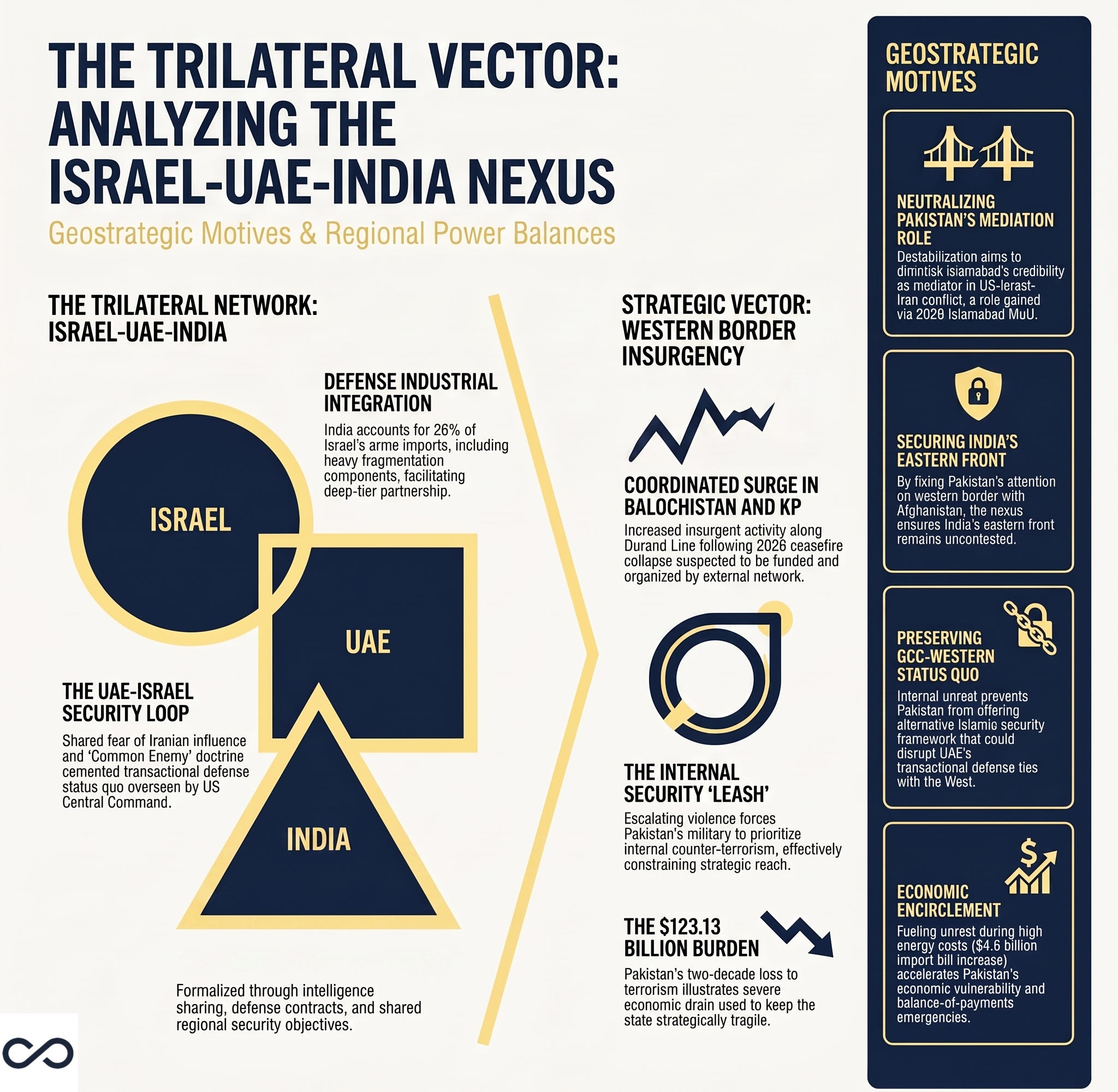
The counter arrived on schedule. Between July 4 and 8, joint attacks by the Balochistan Liberation Army and the Pakistani Taliban killed 42 people, most of them police and soldiers. Pakistan launched Operation Shaban shortly after. The violence surged as the ceasefire it had brokered collapsed, not before it. Prime Minister Sharif named India as the paymaster. What the PM failed to acknowledge, either deliberately or otherwise, was that the “hexagon of alliance” and the Strategic Defence Pact (SDP) between India and UAE joins the interests of these three nations together. Where there is India, there’s likely to be overt and covert support of UAE and Israel. Now whether the Sharifs fail to recognize or acknowledge the nexus because of their own business interests in the country, prioritizing them over national interests and security, remains to be seen.
From its timing and by thinking about who benefits the most, it seems the network joining India, Israel, and the UAE is funding and steering this violence to keep Pakistan looking inward.
For New Delhi, a Pakistan pinned to its western border cannot mass on its eastern one.
For Israel, a Pakistan drowning in its own insurgency cannot broker peace or project weight in West Asia.
For the money from (allegedly) UAE that underwrites the arrangement, a distracted Pakistan preserves the transactional order in which Western and Israeli weapons keep flowing. And their ports maintain their hegemony with no threats from Gwadar.
The timing tells the story. The scale of the attacks, the coordination, the readiness, none of it fits a purely local revolt starved of outside cash.
The purpose is a leash. Keep the security forces busy at home, and a rising mediator is quietly cut back down to a security problem. It is a low-cost, deniable way to neutralise a nuclear-armed state that had started to matter.
Pakistan’s Counter-Moves
Naming the trap is not the same as escaping it. Pakistan has room to move, and the moves are practical rather than dramatic.
First, hold the mediator’s chair. Access is the one asset no adversary can easily take. Pakistan should keep offering neutral ground to Washington, Tehran, Riyadh, and Ankara, and keep its defence pact with Saudi Arabia strictly defensive so Tehran still trusts it in the room. Being useful to everyone is the best insurance against being isolated by anyone.
Second, expose the money. If the funding network is real, then the answer is evidence. Pakistan’s intelligence services should build a documented case on the external capital flows to Baloch and Pashtun militants and take it to the United Nations. Turning a private grievance into a public, evidenced charge shifts the fight from the battlefield to the record, where deniability is harder to hold.
Third, cut the energy exposure. A closed Strait is an existential risk when 85 percent of your fuel runs through it. Pakistan should diversify crude supply away from the Gulf toward Central Asian overland routes, sign longer supply contracts, and treat energy redundancy as a security question rather than a commercial one.
Fourth, protect the remittance lifeline. Record inflows of $41.6 billion in FY26 hold the household economy together, and they sit inside the Gulf’s blast radius. Pakistan should agree emergency evacuation and money-transfer protocols with Saudi Arabia and Qatar now, before a shock makes them urgent.
Fifth, lean on the Chinese rear. Beijing has deep stakes in Pakistan and its own ties to Iran. Building overland trade routes through the China-Pakistan Economic Corridor that skip the Gulf’s contested waters is the slow, structural answer to a structural trap.
The Fault, and the Stars
Geography handed Pakistan the mediator’s chair and the arsonist’s border in the same breath. The stars did not arrange this. Governments did, with invoices and shipping manifests. Which means it can be undone the same way, one honest ledger at a time, if the Muslim world ever decides to read its own accounts.