

Reimagining the Federation of Pakistan
What a pragmatic division into new provinces costs, who pays, and how it can be built inside existing fiscal space

Pakistan cannot progress without divorcing itself from the dilapidated concepts it inherited from its British overlords known for executing poor ideas with flawless sophistication and aristocratic finesse.
The bureaucratic system is one.
The regulatory regime is another.
The provincial demarcation is at the head of it all.
If the fact that all current geopolitical fault lines are a product of British misgivings weren’t enough, their ‘divide and rule’ strategy and the Radcliffe Award gave Pakistan its four units while fomenting territorial disputes in the remaining two.
I focus on the four units in this piece which were drawn for a country of 30 million which grew overtime, exploded rather, to carry more than two hundred and forty as of now.
For example, Punjab governs more people than Germany, France, or the United Kingdom. It does so from one secretariat in Lahore. Sindh runs a megacity of almost twenty five million and a feudal interior from the same building.
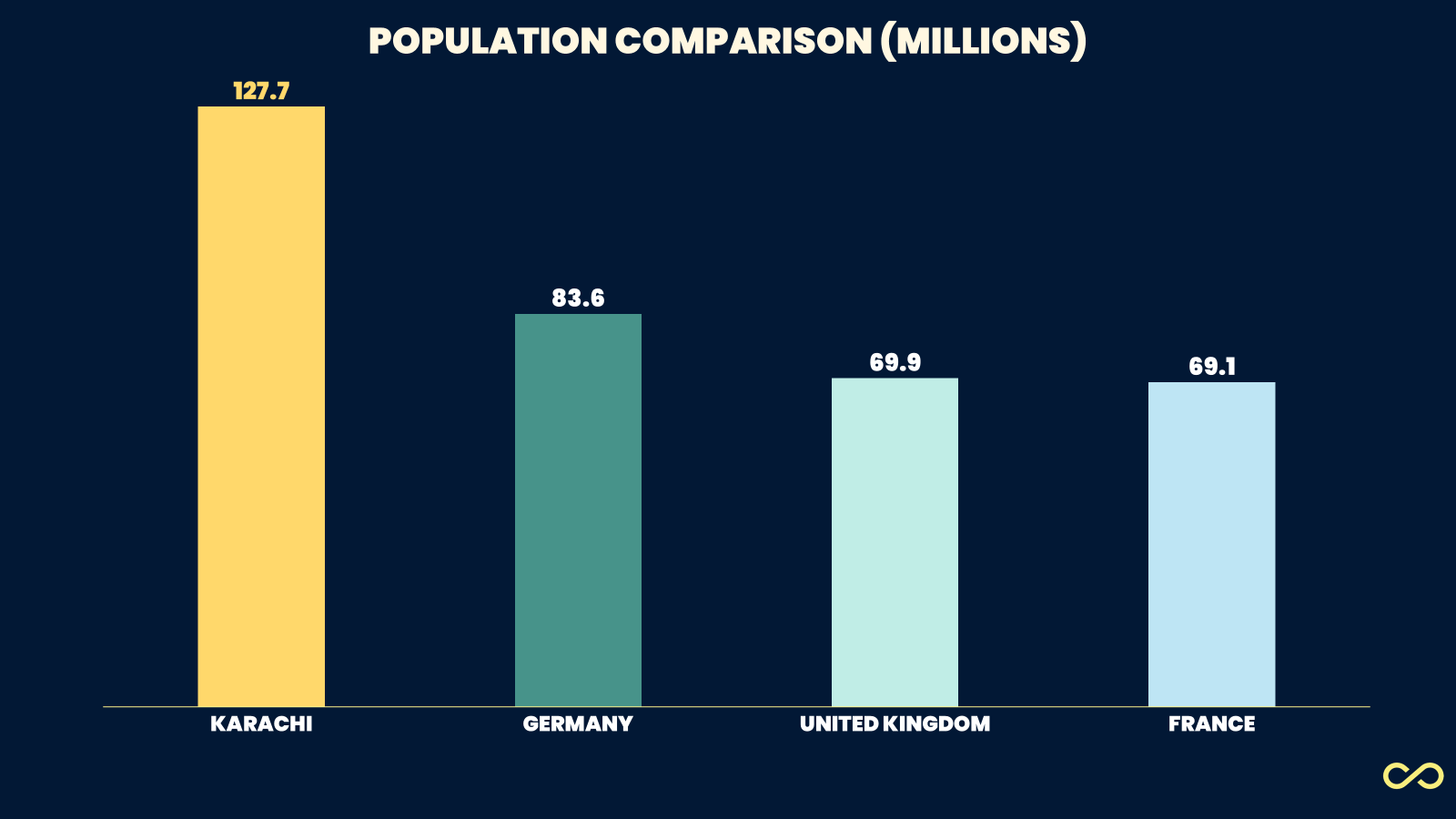
Almost everyone who matters in Pakistan, agrees the map with four units is obsolete.
Consequently, the path to a prosperous Pakistan necessitates the creation of new provincial units.
But no one is willing to pay the price for creating this new map and delivering it in practice. The cost comes in three currencies.
The first is money. A conventional province needs a secretariat, an assembly, a high court, and a revenue board. If the 33 - 36 divisions are given the status of provinces, they’ll break the exchequer before the first one opens its doors.
The second is the finance formula. The National Finance Commission distributes federal revenue mostly by headcount. Apply that to thirty three units and the dense ones absorb the pool while the sparse ones cannot pay their police.
The third is representation. Every province holds equal seats in the Senate. Multiply the provinces and you rewrite the balance of power between the regions, which is the one thing the smaller provinces will not concede.
The number is wrong, but the direction isn’t. We need more provinces for better governance and improved socioeconomic conditions for citizens.
I argue that fifteen units is the point where the map stops failing and the budget still holds, and it sets out what building them would take.
This has been on my mind for sometime and I pen it down not with the intent of inflaming passions, but by objectively, and without sugarcoating, analyzing how the provincial creation might go down, why it is needed, and what will it take to deliver (not in this order).
Defining the rules before the map
Drawing borders is the visible, easier part. The part that decides whether the new units function is the rule set that governs them.
Rausser, Swinnen and Zusman (2010) make the point directly1. Constitutional rules determine who gets access to a decision, what counts as a valid coalition, whether any party holds veto power, what default applies when agreement fails, and which proposals are admissible at all. Governance structures set the boundaries within which political bargaining happens. They call constitutions a subclass of institutions, the rules by which rules are made.
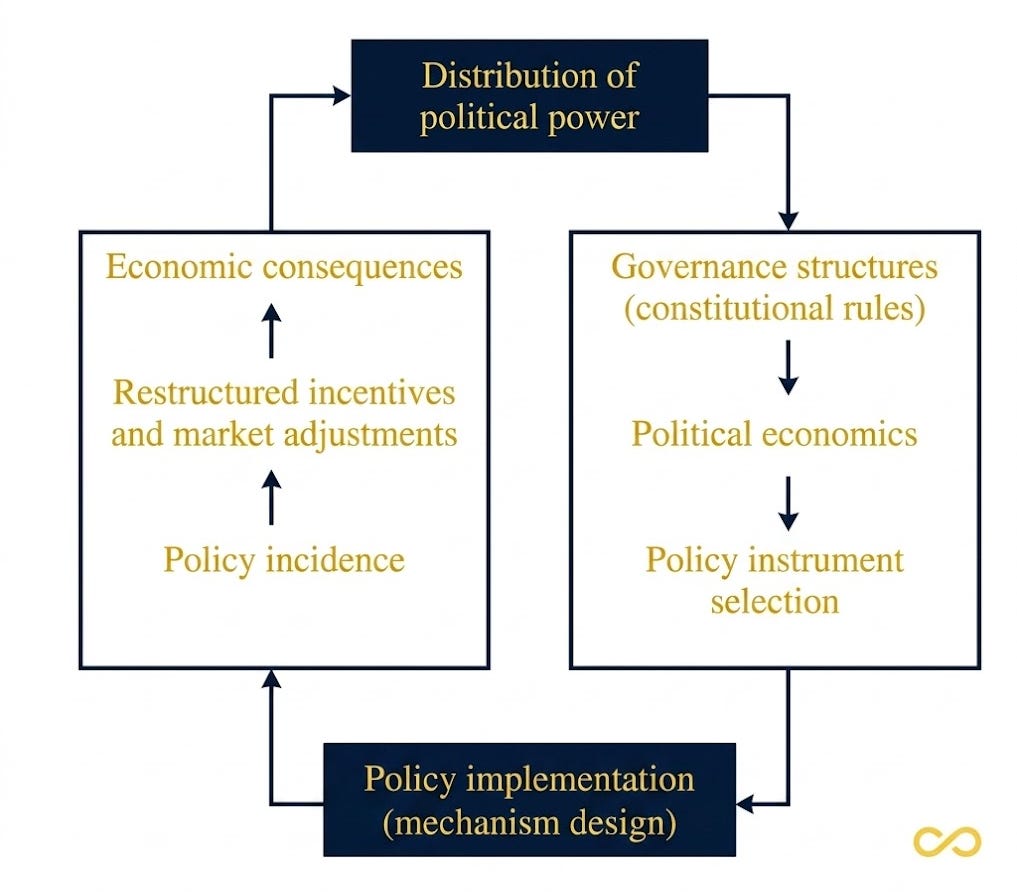
Their second finding is the one that should shape this debate.
Bargaining costs fall when decision authority sits with fewer agents. They rise when it sits with more.
Apply that to a fifteen unit federation. Every water dispute, every finance award, every seat at the Council of Common Interests gains eleven new claimants. Reaching agreement gets harder in proportion.
This sets the design constraint for everything that follows.
A workable division has to cut operating costs at the unit level without letting bargaining costs explode at the federal level.
Those two goals pull against each other.
The rest of this article is an attempt to hold both.
The case for fifteen provinces
Since the focus is on the four provincial territories as stated in the beginning, I will leave out AJK and Gilgit Baltistan from my analysis.
The one for one conversion is the simplest plan to draft and the hardest to fund. Every division becomes a province. Nothing has to be negotiated because nothing has to be chosen.
However, the cost follows the count.
Thirty three secretariats. Thirty three cabinets. Thirty three revenue boards. Thirty three high courts or benches with the judges to staff them. Even at the leanest build, recurring salary and establishment costs scale almost linearly with the number of units.
There is no version of the national budget that absorbs that.
The second failure is the one Rausser and Swinnen predict. Thirty three units puts thirty two new claimants at every finance award, every water allocation, and every seat at the Council of Common Interests. Agreement becomes arithmetically improbable.
Fifteen sits at the point where both curves stay tolerable.
Fiscal load stays inside reach because units can be built from existing offices rather than new ones, which section four sets out. Bargaining load rises but stays inside the range where agreements can be negotiated.
Fifteen also does the political work that thirty three does not need to do and four cannot do.
It breaks the concentration of provincial power without fragmenting the state into units too small to administer themselves.
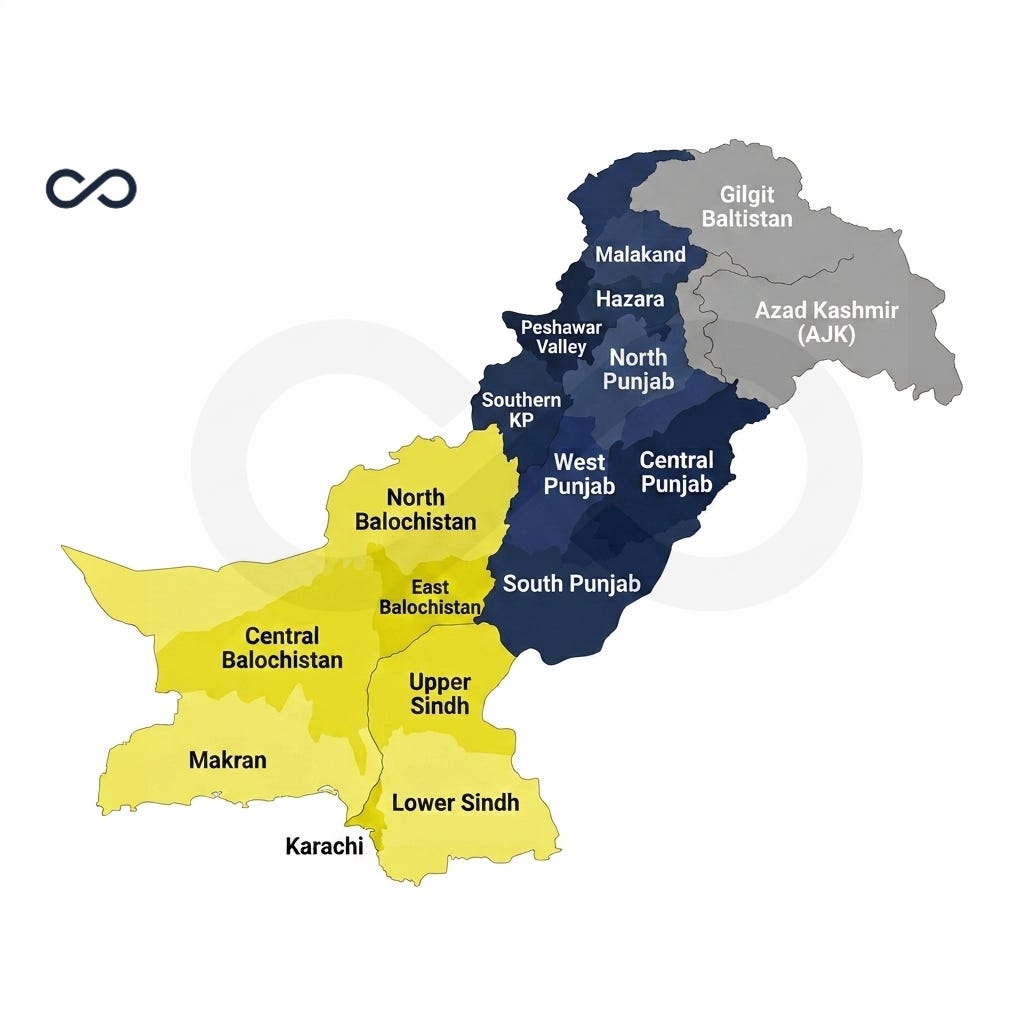
The consolidation:
Punjab, four units.
Central Punjab (Lahore, Gujranwala)
North Punjab (Rawalpindi, Sargodha)
South Punjab (Multan, Bahawalpur, Dera Ghazi Khan)
West Punjab (Faisalabad, Sahiwal)
This division ends the position of Lahore as the seat that decides the federation, and answers the South Punjab demand that has been live for four decades.
Sindh, three units.
Karachi as a metropolitan province
Lower Sindh (Hyderabad, Mirpur Khas)
Upper Sindh (Sukkur, Larkana, Nawabshah)
Separates the revenue base of Karachi from the rural interior.
Khyber Pakhtunkhwa, four units.
Peshawar Valley (Peshawar, Mardan)
Hazara (Abbottabad, Haripur)
Malakand (Swat, Chitral)
Southern (Kohat, Bannu, Dera Ismail Khan)
Gives Hazara the autonomy it has requested for decades. Isolates the merged tribal districts for focused administration.
Balochistan, four units.
North or Pashtun belt (Quetta, Zhob)
Central (Kalat, Khuzdar)
Makran Coast (Gwadar, Turbat)
East (Naseerabad, Sibi)
Separates the Pashtun north from the Baloch south. A dedicated Makran unit puts Gwadar under an administration sized to it.
Building the fifteen provinces for almost nothing
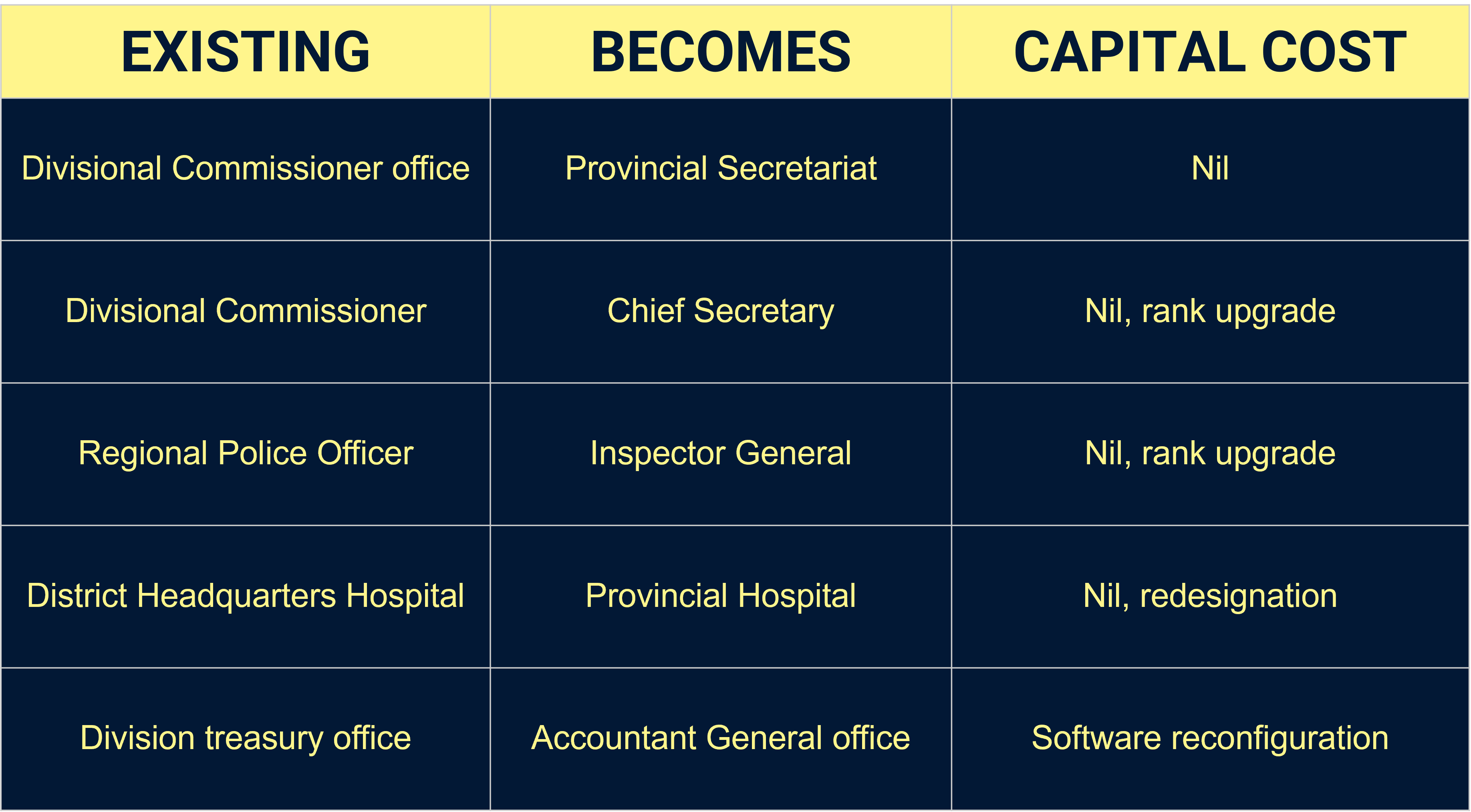
The cost problem disappears if the new units are assembled from offices that already exist.
Every division already runs an administrative headquarters, a police command, a treasury, and a tertiary hospital. Converting a division into a province is a matter of redesignation, not construction.
The courts follow the same method. Amend Article 192 so a High Court may exercise jurisdiction over more than one province, or so a permanent bench may be elevated to a High Court using its existing premises. The Rawalpindi bench becomes the North Punjab High Court. Multan and Bahawalpur merge into a South Punjab High Court. The existing pool of judges is divided by territory rather than expanded.
The legislature costs nothing if it is not separately elected. Existing MPAs transfer to the new jurisdictions. Cabinets are capped at five to seven via constitutional amendment.
Duplication is prevented by keeping some functions shared.
Golden opportunity for civil service reforms
The formation of new units also provides a once-in-a-lifetime opportunity to reform civil bureaucracy. Through a constitutional amendment, maybe the upcoming 28th, it can be mandated that all "Provincial Secretariats" in the 15 new units are staffed by lateral hires or performance-based contract employees, rather than the existing cadre of All-Pakistan Services (PAS/PSP). Once recruited, an up-or-out model similar to one seen in top global corporations, and even in the military, can be adopted for them to progress and eventually weed out the entrenched and archaic civil services currently in place. The benefits are immense. You won’t have a generalist administering public financial management, or doing as an agri expert - as is the case with PAS now.
The move will face resistance, similar to why such reforms failed in the past. Historically, senior bureaucrats neutralised reforms by relying on Article 240 of the Constitution, Section 3(2) of the Civil Servants Act 1973 (which protects terms and conditions from being "varied to disadvantage"), and staying protected through the Federal Services Tribunal (FST) and High Court stay orders.
If the 28th amendment includes an explicit non-obstante clause directly targeting Article 240 and the 1954 CSP Cadre Rules, something like:
“Notwithstanding anything contained in Article 240, Article 241, the Civil Servants Act 1973, or any judgment of any court, all cadre reservations, quotas, and automatic postings reserved for All-Pakistan Services (PAS/PSP) in provincial posts shall stand dissolved within 36 months of this Amendment.”
The cadre monopolies can be abolished.
Article 212 can also be amended to strip the Federal Services Tribunal (FST) and provincial High Courts of jurisdiction over restructuring, post-abolition, and cadre dissolution. All service-related appeals are redirected exclusively to a specialized Administrative Restructuring Bench of the Federal Constitutional Court (FCC), pre-mandated to prioritize state efficiency over individual tenure rights.
Dealing with the pushback
Upon enactment, all Grade 19–22 officers of the PAS, PSP, and Secretariat Groups are declared part of a temporary "Federal Surplus Pool" under a modified Section 11A of the Civil Servants Act 1973. Officers are given a strict 180-day window to select one of three irrecoverable options:
A. Officers permanently transfer to one of the 15 new Provincial Management Services (PMS). They forfeit their federal seniority and federal inter-provincial transfer rights. They become local employees of that micro-province, with pay scales and renewals re-negotiated under 3-to-5-year performance contracts managed by the new Provincial Public Service Commissions.
B. They accept immediate voluntary retirement with an upfront lump-sum annuity payout.
C. Officers who refuse both Options A and B are placed in an unassigned "Surplus Pool" on basic pay, stripped of all perks (no official vehicles, no executive allowances, no discretionary funds). Under the amended Section 11A, if an officer remains unassigned in the Surplus Pool for 12 consecutive months, their service is automatically terminated with standard statutory severance, legally bypassing standard Efficiency & Discipline (E&D) inquiry processes.
The reforms are likely to bring massive savings. Pakistani civil servants fight for the monetizable privileges attached to administrative discretion and postings. With the sunset clause, and the induction of professionals on performance based contracts, the country can do away with multi-billion rupee land distribution schemes and post as well as pre-retirement sinecures for the civil servants.
Now the traditional response of the Pakistani civil service to any aggressive reform effort has been "work-to-rule" or file slowdowns. This includes deliberately withholding signatures to paralyze government functions until the political leadership backs off. Civil servants rely on Rules 8, 11, 12, 14, and 18 of the Rules of Business, 1973 to this effect. By exploiting the strict, mandatory consultation clauses in these rules, they legally delay files for months by creating endless cycles of inter-departmental queries.
To counter this would require amending the Civil Servants (Efficiency and Discipline) Rules 2020 alongside the National Accountability Ordinance (NAO) where deliberate file paralysis or organized administrative slowdown during a declared constitutional transition is reclassified as "Administrative Sabotage of the State" with any civil servant found guilty of doing so faces summary dismissal, asset freeze and imprisonment.
Money
Fifteen lean units cost little to build. They still have to be funded. This brings us to reforming the NFC formula. Not an easy task given the constitutional obstacles it may face.
The first one is Article 160(3A), inserted by the 18th Amendment, which prevents the provincial share of the divisible pool from falling below the previous award.
That share now stands at 57.5 percent.
If macro portfolios like higher education, energy, climate policy, inter-provincial transit return to the centre, the centre will need a larger share to run them.
The clause has to be repealed and the split moved toward 50/50, or a better proportion (left with an expert to judge).
The second obstacle is the NFC formula itself.
At 82 percent population weighting, Karachi, Central Punjab, and Peshawar Valley absorb most of the pool. Makran, Upper Sindh, Most of Balochistan and Southern Khyber Pakhtunkhwa aren’t left with the resources to run basic services.
The current formula is a population trap. A 15-province model requires shifting the financial weight from how many people you have to how poor your region is and how hard it is to govern.
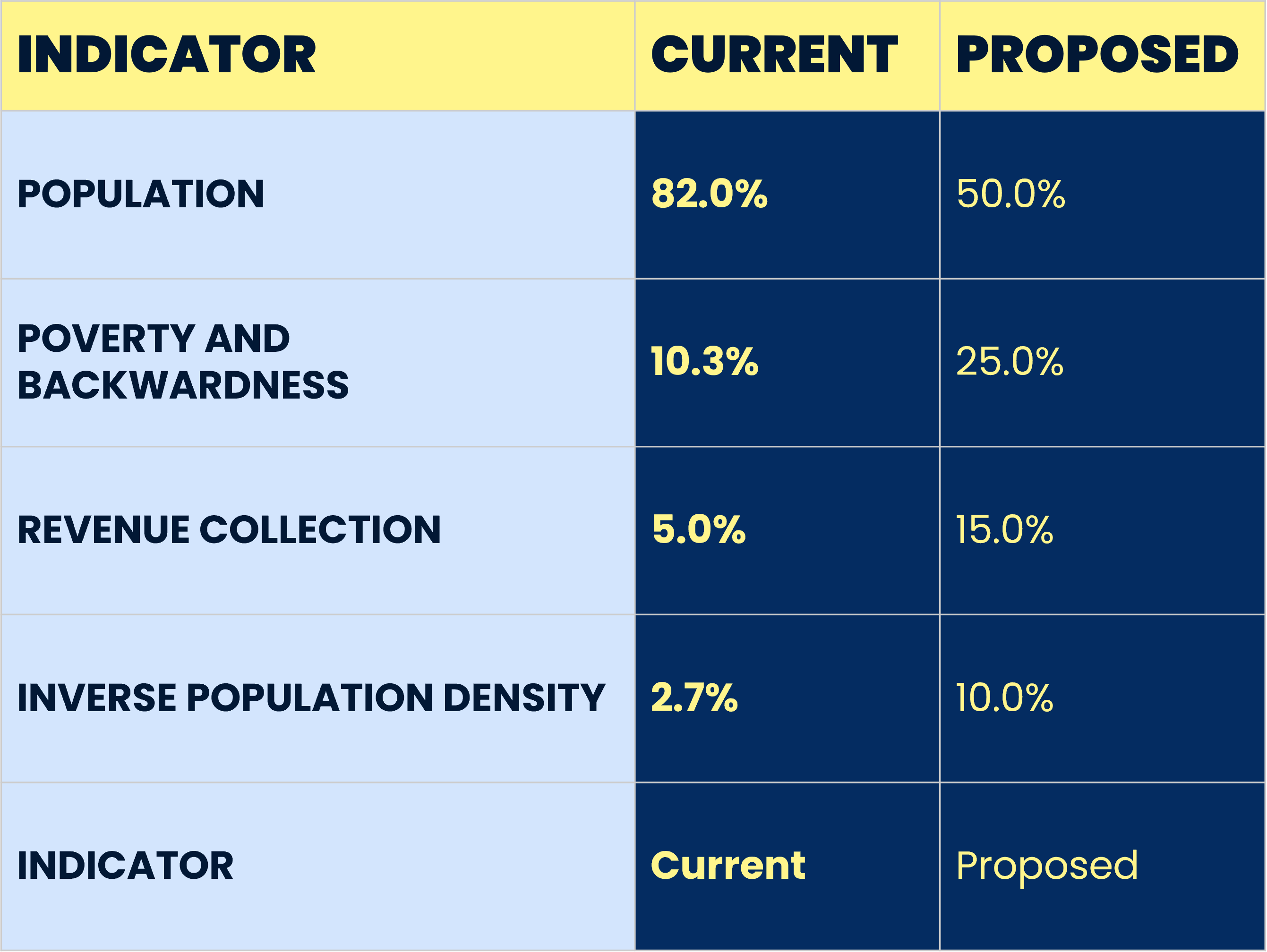
Even with a shifted formula, certain micro-provinces (like Malakand or East Balochistan) simply do not have the industrial or agricultural base to survive on formulaic transfers alone.
If the creation of provinces is done via the 28th Amendment, it would need to establish a constitutionally protected Federal Equalization Fund. Modeled after systems in Canada and Australia, the center would withhold a specific percentage of the total budget (e.g., 3-5%) before the NFC is even calculated. This fund is distributed as direct, non-lapsing grants exclusively to provinces whose per-capita revenue falls below the national average. It acts as an economic floor, ensuring no province defaults on basic service delivery.
Then there is the issue of sustainability via revenue generation and tax collection. Fifteen units cannot survive on federal transfers alone. The amendment has to require them to raise property tax and agricultural income tax, the two bases the current elite refuses to touch, and dock transfers by an equivalent share where collection targets are missed. That forces local politicians to tax their own constituencies or run out of money.
Cutting the population weight has a second effect worth stating. Today, a province with more people receives more money. That gives every provincial government a reason to let its population grow and no reason to slow it. Reduce the weight to 50 percent and that reason disappears.
The political consequences
Opposition to this design will be inevitable. Each major party loses something.
Pakistan Peoples Party loses Karachi and the revenue base attached to it, along with the unified Sindh platform. It might retain uncontested control of two rural units in Upper and Lower Sindh.
Pakistan Muslim League (Nawaz) loses the demographic weight that lets it form federal governments while losing everywhere outside Punjab.
Pakistan Tehreek-e-Insaf loses its populist wave as fifteen units make elections local, where patronage beats broadcast. Khyber Pakhtunkhwa splitting four ways confines its base to two of them.
There will be winners too, who will gain via new provinces and get a platform they had been denied for long.
Smaller parties like PML-Q and the Istehkam-e-Pakistan Party (IPP) gain Chief Minister offices across North and South Punjab.
Local clan elders and independent electables gain massive leverage across rural Punjab and Khyber Pakhtunkhwa.
Sub-ethnic and regional movements in the Saraiki belt, Hazara, and Malakand gain formal state recognition and local budgets.
Grand Democratic Alliance (GDA) gain governable territories in Upper and Lower Sindh.
This changes the lower and upper house dynamics too.
The Senate protects smaller provinces from Punjab. Twenty three seats per province, regardless of population, is the protection. Split Punjab four ways and it inverts: four successor units at twenty three seats each gives the former Punjab territory ninety two seats in a chamber of a hundred and sixty five, fifty five percent of the upper house.
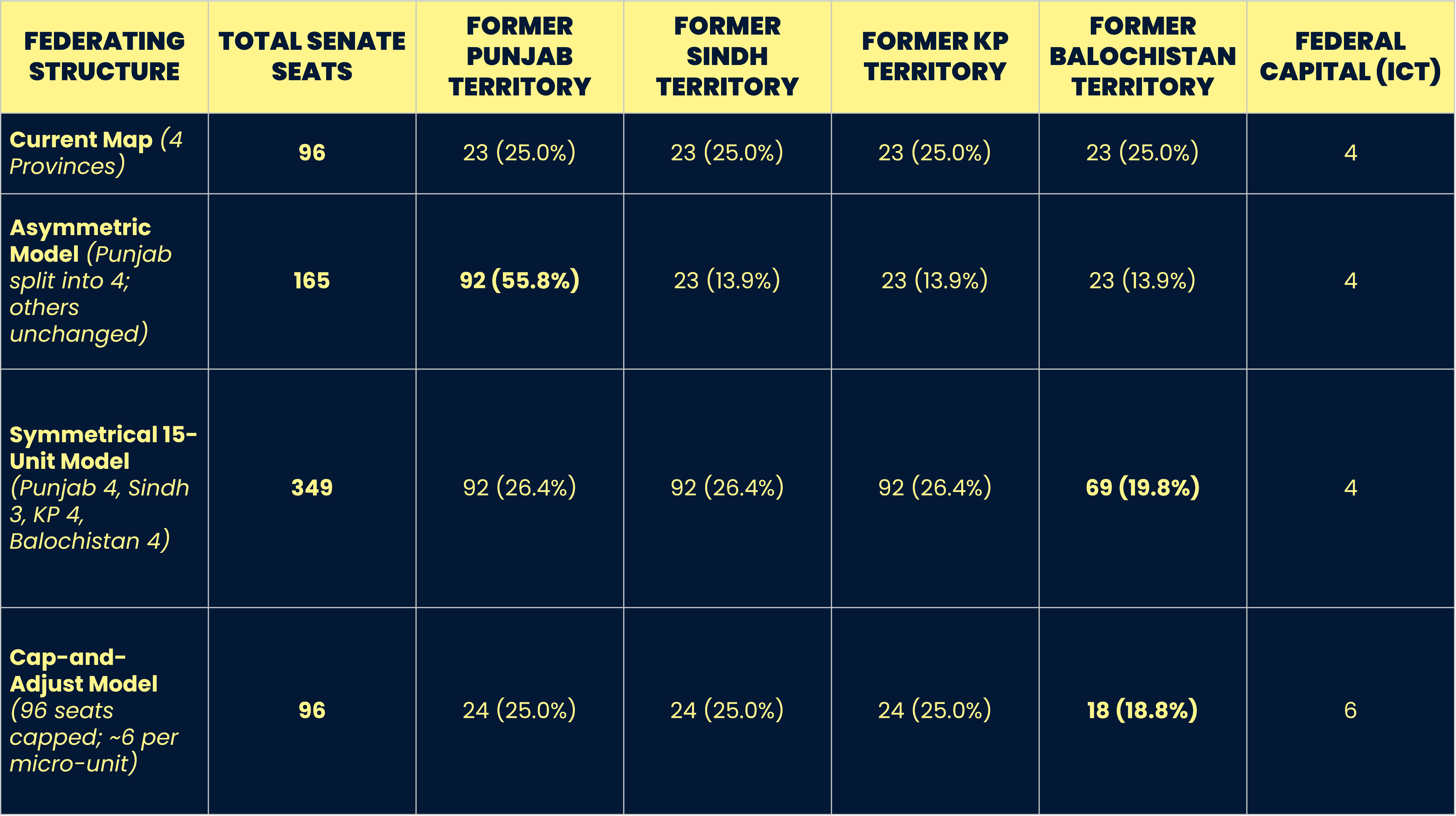
If all four provinces are split simultaneously into 15 units (e.g., 4 Punjab, 3 Sindh, 4 KP, 4 Balochistan) and the 23-seat equal representation rule per province is preserved, the Senate balloons from 96 seats to 349 seats. To prevent this mathematical inversion from creating a constitutional crisis, the 28th Amendment cannot rely on Article 59 in its current form. It would need to be amended so that the equity and the number of seats at the senate remain harmonized.
The Council of Common Interests faces the same recalculation. Under Article 153, the CCI currently operates as an 8-member body: the Prime Minister, 3 Federal Ministers, and 4 Chief Ministers. It handles macro-inter-provincial friction points: water sharing (IRSA), energy grids, petroleum royalties, and census approvals. Expanding the table to 15 Chief Ministers plus federal members (19+ participants) turns an executive decision-making body into an unmanageable, permanent debate society. The solution to this is very simple. CCI has not been an effective body anyways. Article 154(3) mandates that the CCI must meet at least once every 90 days. In practice, successive federal governments routinely ignore this rule, delaying meetings for 6 to 12 months, particularly when contentious inter-provincial disputes are brewing. It has been a frequently bypassed and ineffective forum, redundant with the existence of other forums like the SIFC Apex Committee or the National Security Council which can perform its function just as well. A future amendment should consider the abolishment of this redundant body.
The National Assembly is a different mechanism. The National Assembly seat allocation (Article 51) relies entirely on population. Restructuring administrative boundaries does not alter demographic realities, it transforms how those seats function politically. It ends Punjab’s hegemony of forming the federal government, forces federal bargaining as the Prime Minister has to form a government of loose coalition, and supports better socio-economic outcomes as a consequence of that bargaining. In my opinion, the benefits outweigh the costs no matter what vantage point you are looking at from.
Gauging the impact and likely outcomes
The outcome is governed by two variables:
The fiscal space exists to fund the transition.
The political consensus holds long enough to legislate it.
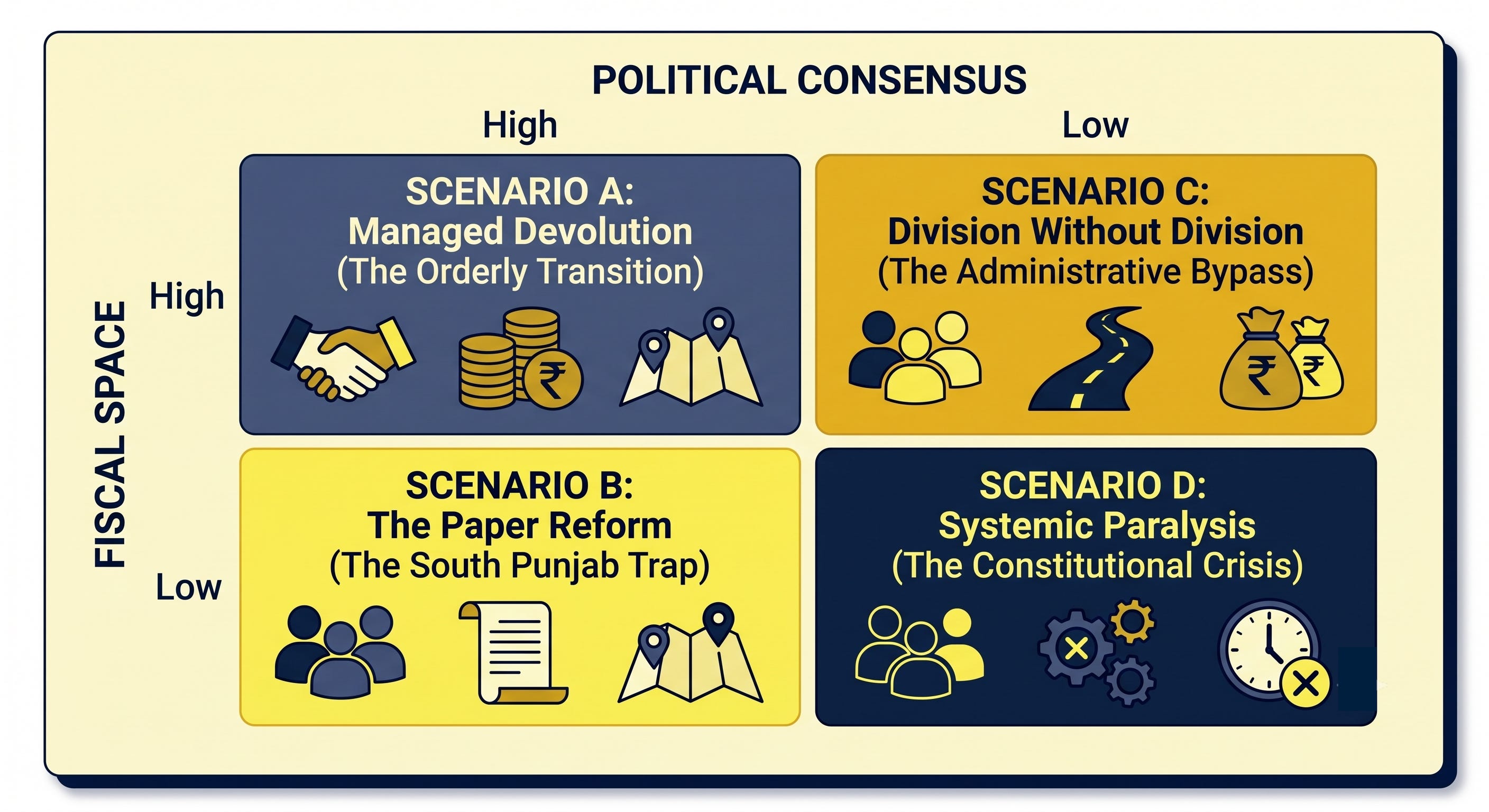
Consensus with fiscal space (Managed Devolution): The Senate is capped, debt is apportioned by an independent commission, and shadow secretariats manage a clean 18-month handover.
Consensus without fiscal space (Paper Reform): The map changes, but macro-economic realities leave no money to fund the new secretariats. South Punjab and others become nominal provinces with no actual budgets.
Fiscal space without consensus (Division Without Division): The amendment fails because the smaller provinces refuse to reopen Senate representation. The demand for local governance does not disappear.
Neither (Systemic Paralysis): The map is forced through without settling Senate seats or dividing debt. The new units cannot meet payroll within a fiscal year. The upper house deadlocks over representation. The reform produces the paralysis it was meant to cure.
What would have to be true
The physical build cost of a 15-province federation is solvable, not impossible if the will to execute exists.
As outlined, existing commissionerates become secretariats, divisional benches become high courts, and municipal halls house new assemblies.
Nothing has to be constructed.
For these units to function, there are certain structural realities which will need to be addressed via any future constitutional amendment designed to make this happen. I won’t go into them again as they have already been discussed above.
Pakistan’s current geopolitical and economic fault lines are the delayed consequences of lines drawn poorly in the past. To draw new ones requires acknowledging a blunt reality: Maps can be drawn in a week. Federations are built in the ledger.
© 2026 Syed Ali Shehryar | Connect with me on LinkedIn | Subscribe to never miss a post
Rausser GC, Swinnen J, Zusman P. POLITICAL POWER AND ECONOMIC ANALYSIS. In: Political Power and Economic Policy: Theory, Analysis, and Empirical Applications. Cambridge University Press; 2011:1-2.