

How Governments Think When They Are Designed To Learn
A working model for converting institutional memory into adaptive public intelligence

In my last post, I argued that most governments don’t fail because they lack data. They fail because they forget. Repeatedly.
This post is the promised follow-up: the model I use to explain why that happens and how we could build something better.
I call it a Three-Layer Cognitive Architecture.
It is neither a product nor a platform. It is a design structure that helps systems learn across time.
Here’s the visual breakdown I have tried to create for this model.
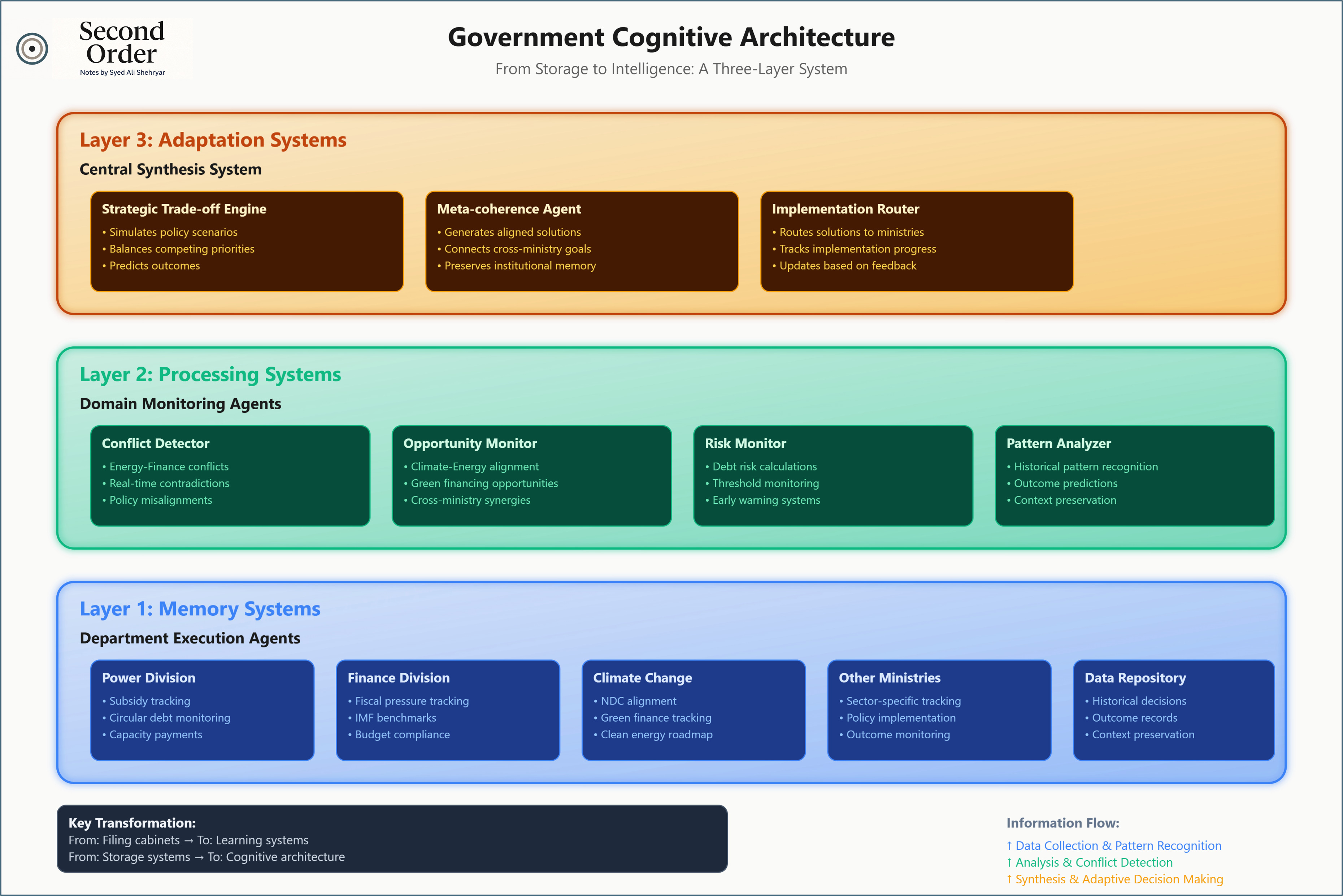
Layer 1: Memory Systems
This is the foundation. It includes all the executional units: ministries, departments, divisions. They generate records, reports, audits, performance logs.
Layer 2: Processing Systems
This is where contradictions emerge and usually get ignored.
In the cognitive architecture model, Layer 2 is where agents monitor cross-domain contradictions.
Things like:
Energy vs. finance trade-offs
Climate targets vs. subsidy structures
Debt risks across ministries
Without this layer, systems stay siloed. You can track performance within departments but miss the policy incoherence between them.
Layer 3: Adaptation Systems
I call it the central synthesis system. The brain to help decisions become smarter.
This is the strategic core. The meta-layer that asks:
What did we miss?
What didn’t work?
What do we need to change?
It links learning to power. That’s what makes it different from M&E (monitoring and evaluation) dashboards, which often report but don’t trigger new action paths.
With this layer in place, you can do things like:
Simulate trade-offs
Run policy outcome forecasts
Route revisions to implementation teams
When it works, it becomes a self-adjusting system. The absence of this layer is why most digital governance efforts turn into expensive storage closets instead of learning engines.
So what does this look like in practice?
Let’s make it real with a federal-level Pakistan example.
🧾 Case: Circular Debt and Energy Subsidy Misalignment
Memory layer: Power Division tracks subsidy disbursements; Finance monitors IMF benchmarks; Planning Division holds NDC climate targets.
Processing layer: A domain agent detects real-time contradictions between green energy plans and continuing fossil fuel subsidies.
Adaptation layer: A central coherence agent simulates trade-offs, prioritizes interventions, and routes revised subsidy design for implementation.
Now apply this structure across every policy domain. That’s how institutional learning becomes a system!
As I previously mentioned, the point isn’t to “automate governance.” It’s to make it less forgetful, more coherent, and more trustworthy.
That can only happen when memory, monitoring, and adaptation are structured as a stack, not as scattered pilot projects.
Final thought.
If your government, agency, or organization keeps making the same mistakes, it’s probably not a people problem. It’s a system memory problem.
This model helps me explain why. I hope it helps you see it too.
New here?
This is part of a broader series I’m writing on how institutions think, fail, and (sometimes) improve. If you work at the intersection of tech, policy, or public design, there’s more coming albeit intermittently.
→ Subscribe to receive field-tested models, case-based failures, and real-world system redesigns that help you think structurally, not reactively.