

Black Rain Over Tehran: The Casualties No One Is Counting
Countries in South Asia and GCC need urgent measures to test air and seafood and block toxins from the strikes on Tehran's oil depots, or risk more lung deaths and cancers by 2030.


To all those making motivational content and videos on 2025 was a trailer, 2026 is going to be the year we build an empire… please shut up! You’ve already jinxed it and we’re not even half way through the year.
On March 8, 2026, Tehran woke up to a blackened rainfall. Residents reported rainfall that left oil stains on clothes, burned skin on contact, and corroded car paint.
Iran’s Red Crescent Society confirmed that US and Israeli airstrikes on fuel depots and an oil refinery in Alborz province released hydrocarbons, sulfur oxides, and nitrogen oxides into the atmosphere.
When those gases mix with water in clouds, they fall as acid at a pH of 4.0 or below, far more corrosive than normal rain at pH 5.6.
The strikes also sent PM2.5 particles, polycyclic aromatic hydrocarbons (PAHs), and heavy metals vaporized from building materials into the air above a city of 10 million people.
The media covered the fires. The story that will matter for the next decade is the one no agency is currently measuring.
Gulf water at risk
The Persian Gulf sits downstream from all of this, in every sense. It’s a semi-enclosed basin with one exit point, the Strait of Hormuz, and a water residence time of two to five years under normal tidal conditions. That means whatever enters the water stays there, mixing through the whole system, before it slowly flushes out.
Benzene, one of the primary compounds released by burning crude petroleum, dissolves directly into seawater. It also passes through reverse osmosis membranes at measurable concentrations.
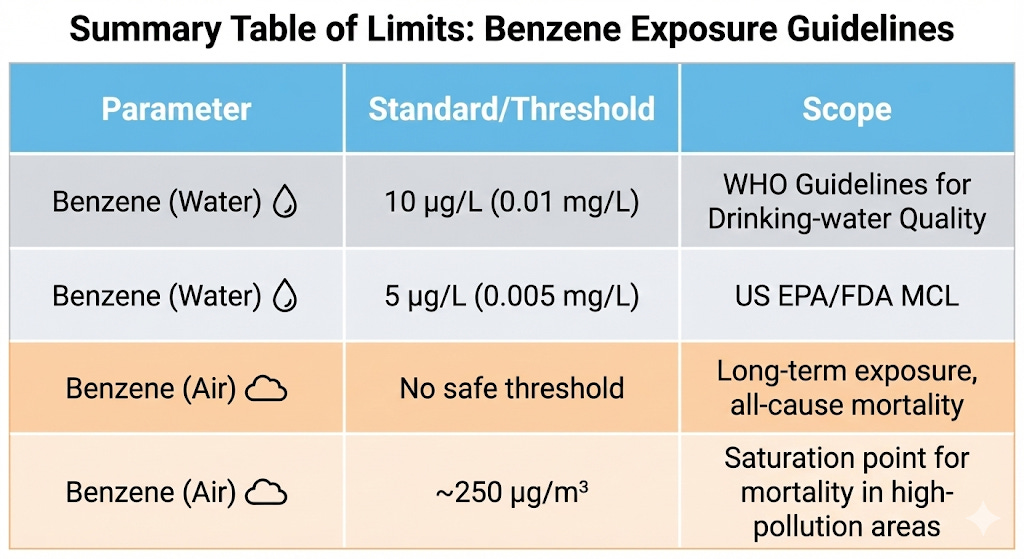
Every major desalination plant across the Gulf runs on reverse osmosis technology, and those plants supply drinking water to roughly 50 million people across seven countries. The World Health Organization’s safe limit for benzene in drinking water is 10 micrograms per litre. The US Environmental Protection Agency (EPA) sets a maximum contaminant level of 5 micrograms per litre.
As of this writing, no Gulf government has published a single water quality reading since the fires began.
That gap is not a communication problem. It’s a decision problem. Water testing baselines need to be established now, while contamination is still attributable to a specific event on a specific date. Every day without a reading is a day of baseline data that cannot be recovered.
If benzene levels are later found in Gulf desalination output, and no measurements exist from March 2026, there’s no legal or scientific anchor for when contamination entered the system.
The causal chain breaks, and with it, any path to accountability.
Seafood chain contamination
The food supply chain adds a second exposure route that moves more slowly but compounds over time.
Benzene itself evaporates relatively quickly from surface water.
PAHs from oil combustion behave differently: they bind to organic particles, settle into sediment, and accumulate as they move up the food chain.
Phytoplankton absorbs them first.
Small fish that feed on phytoplankton carry higher concentrations. Larger commercial fish carry higher still. The Persian Gulf’s commercial fisheries supply populations across all seven bordering countries and export to South Asia and East Africa.
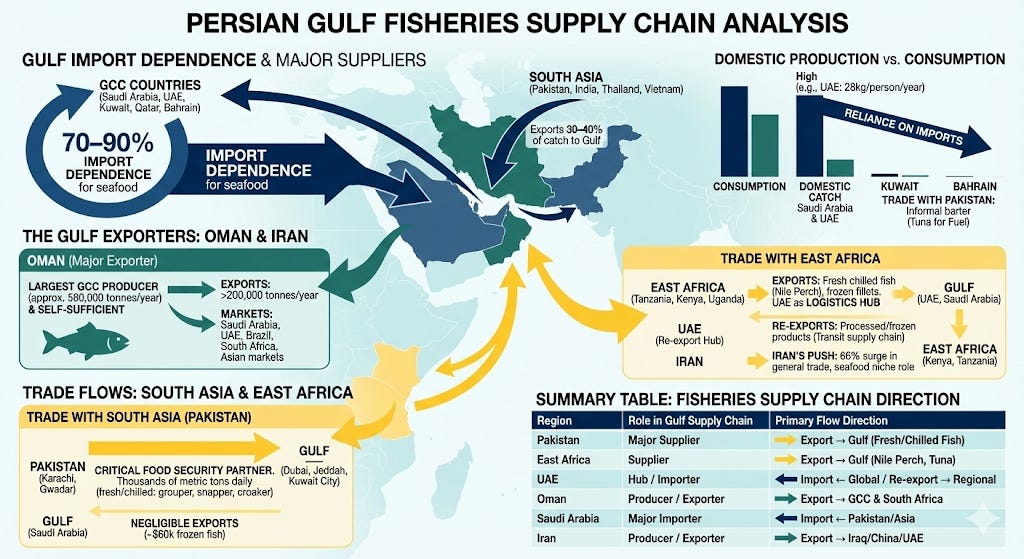
No Gulf government has issued a seafood safety advisory. The window for establishing pre-contamination baselines in fish tissue is also closing.
Winds carry the danger forward
Wind direction adds a third vector. The prevailing atmospheric pattern over the Gulf in March carries particulates northeast, over Iran, then into Pakistan and northwestern India.
Pakistan’s air quality monitoring already recorded dangerous particulate concentrations before the depot fires. Cities like Lahore regularly exceed 100 micrograms per cubic metre of PM2.5, well above the WHO’s guideline of 15 micrograms per cubic metre as an annual mean.
Atmospheric scientists have established that PM2.5 concentrations above 35 micrograms per cubic metre produce measurable increases in respiratory mortality within 72 hours of sustained exposure, and that the dose-response relationship steepens sharply around 250 micrograms per cubic metre, a level Lahore reaches during peak pollution episodes even without additional inputs.
The corridor affected by this event holds over 540 million people. No international environmental body has published current atmospheric readings for it since March 8.
The question this raises is not primarily humanitarian. It’s about asset assumptions. Gulf investment theses in water infrastructure, food supply, and real estate rest on the premise that these systems are stable and supply is assured.
A contamination event in desalination output, even a sub-threshold one, would produce public pressure for disclosure that governments are currently avoiding.
The long shadow of delayed harm
Undisclosed contamination that surfaces in 2029 or 2032 carries a different risk profile than one disclosed and managed now. The healthcare burden from PAH and benzene exposure typically appears in oncology and pulmonology wards eight to fifteen years after the event. Those costs land on national health systems, on insurance pools, and on populations whose consumption patterns sovereign investors are pricing into their long-range models.
Qatar’s prime minister warned, before this escalation began, that a contamination event in the Gulf could leave the country without potable water in three days. Qatar has since built emergency water reserves. Most of its neighbours have not built equivalent monitoring infrastructure. The monitoring gap is itself a governance risk that any serious political risk assessment of Gulf assets should now include.
The first set of casualties from March 8 will appear in the near term: in hospitals near the strike sites, in official statements about the military operation, in diplomatic fallout.
The second set will appear in hospital records between 2030 and 2040, in populations that live close to the Gulf’s coastline and water infrastructure, who had no role in the decision to strike and no legal relationship with the parties that did.
Those records will be compiled by researchers whose findings will not trend anywhere. Benzene and PM2.5 don’t observe ceasefires.
What policymakers need to do, and fast
The action available right now, to any government in the region with access to a water testing laboratory and an air quality monitoring station, is to take readings and publish them.
That’s it.
The data either shows the system is clean, in which case publishing it is reassuring and costs nothing, or it shows contamination is present, in which case the earlier it’s found the more options exist for response.
Waiting produces only one outcome: a smaller set of choices, further down the line, for a larger set of people.