

The Five-Billion Rupee Shortcut
What I diagnosed for free, the government paid billions to get wrong.

About two years ago, I found myself in yet another crisis situation.
Crises is a recurring side effect of governance failures, and almost everyone involved ends up firefighting and detracted. A tirade for another time.
Pakistan, operating within a fiscally constrained space, had no option but to unlock capital through Government-to-Government (G2G) investment opportunities. IMF financing provided breathing space, not revival. Pitching co-investment opportunities to sovereign wealth funds was the path to unlocking resources for economic revival and growth.
The government assembled a portfolio of infrastructure projects across energy, mining, agriculture, and critical infrastructure. They were technically sound, politically endorsed, and had passed preliminary screenings.
A high-level delegation from one of the world's largest sovereign wealth funds arrived for a bilateral investment conference. The initial reception was positive. The follow-up, however, was not.
The problem laid with the materials developed. They had been built by a generalist bureaucracy whose instinct was to satisfy internal approval committees, so they answered the wrong questions entirely: What did the country need? What could this project deliver domestically? What is the policy rationale?
A sovereign wealth fund which sat on a billion dollars it needed invested would ask none of those questions.
Someone noticed the gap. A cohort of advisors and consultants was assembled for the revision exercise. I'd be the only one without a financial pedigree in the group.
To add to the occasion, we were told a senior minister with the energy portfolio (and who was later moved to the climate change ministry) would interview the team before work could begin.
I didn't wait for the interview.
I’m an engineer by training, and I’ve spent most of my career solving problems across sectors I had no prior domain expertise in. What I’ve learned is that subject matter is rarely the real constraint.
The constraint is almost always structure.
Break any problem into its smallest components, solve each layer, and the answer assembles itself. That instinct is often faster than domain expertise, especially when the domain is new.
I took this mindset to the engagement.
I framed the question plainly:
What will it take to bridge the gap between what the government presented and what sovereign investors needed, fast enough to keep investment windows open, without rebuilding entire portfolios from scratch?
My answer was structured diagnosis in three sequential steps:
Map each project against what the investor looked for (which practice meant scoring each project like a buy‑side analyst would: against the fund’s strategi sector fit, alignment with overall vision, risk‑adjusted IRR, economic spillovers, ESG eligibility, ecosystem fit, ticket size, and governance structure),
build a risk narrative that puts contractual protections front and centre rather than buried in appendices, and
present deal-ready signals so investors stop asking “tell me about this project” and start asking “what do we need to do to move to the next stage?”
I completed the full diagnostic over a weekend, alongside my existing work as a fulltime consultant supporting multiple initiatives at the Prime Minister’s Office.
This included two investment pitches to illustrate my diagnostics alongside recommendations. All of it was pro bono, to save time, and to hit the ground running as soon as possible. I wanted to use the “interview” to prioritize the next steps instead of wasting more time.
Then the minister arrived, four hours late.
What followed is worth recording because it captures something about how Pakistan loses ground. He was not curious about the work. He was concerned with my age, my lack of financial credentials, and why I couldn’t produce anything useful without treating his ministry as a second home.
He had shown up four hours late to a free consultation and still felt entitled to audit its quality.
Churchill observed that the greatest lesson in life is knowing that even fools are sometimes right. The minister had a point about rigour. His error was the certainty that rigour could only arrive with the right letterhead.
I handed him the draft and left.
Lesson internalized: never volunteer in an environment that mistakes generosity for obligation. More practically, never give something for free to someone who will only value it once they have paid someone else for the same thing.
Which is what happened next.
The framework I'd built identified four structural gaps in how the portfolio had been presented.
The first was archetype mismatch. The investor had clear criteria: strategic alignment with their national development goals, returns above 12% USD IRR, supply chain or innovation components, ESG fit, and defined partnership structures. Fewer than a third of the presented projects scored high across all five. A portfolio meant to attract a specific thesis had been assembled as if the investor would browse and self-select. Sovereign funds invest to a thesis, and when materials aren’t filtered against it, the investor’s analysts do the sorting. That friction stalls momentum and signals that the sellers don’t understand the buyer. No CFA was needed to come to this conclusion.
The second gap was risk framing. Contractual protections existed, and they included government guarantees, 25-year binding off-take agreements, and international arbitration clauses. But they were buried in supplementary documents instead of sitting at the front of the narrative. Risk doesn’t disappear because you put it in an appendix. It just tells the investor you haven’t thought carefully about what they’re going to ask.
The third was deal readiness. No stage gates mapped. No approvals listed. No timeline to the next milestone. With the pathway unclear, every investor would have questions. And every question an investor asks adds friction. And friction kills deals that might otherwise close.
The fourth was strategic alignment. Not one project had been connected to the investor’s long-term capital deployment thesis. The government had failed to factor in that investors at this level don’t buy individual project merit. They buy fit with a strategy they’re already executing.
The fix for each was specific and structured:
Sort the portfolio ruthlessly and present only the tier that genuinely fits.
Convert risk disclaimers into contractual architectures, showing what structure contains each risk and how it survives a change of government.
Build a one-page investment memo per priority project, eight components only: value proposition, market context, business model, capital required, financial summary, key facts, and deal-readiness status.
Make sure that every line answered one investor question. Nothing decorative.
The framework fed into the assembled group’s direction which would later use it to produce investment teasers for the investors. Those teasers became the foundation on which the consulting firm hired later subsequently built.
Shortly after the conference, the government formally acknowledged what I’d diagnosed informally: the sovereign fund representatives at the investment conference had complained about the low quality of investment documents, and the bureaucracy lacked the skill sets to prepare investment-grade projects. The group that was assembled, with the right credentials after I dropped out, did not produce the ‘wow’ factor needed. What that was is anyone’s guess.
The government’s solution, however, was to hire a foreign consulting firm for PKR 5.43 billion over three years, approved in July 2025.
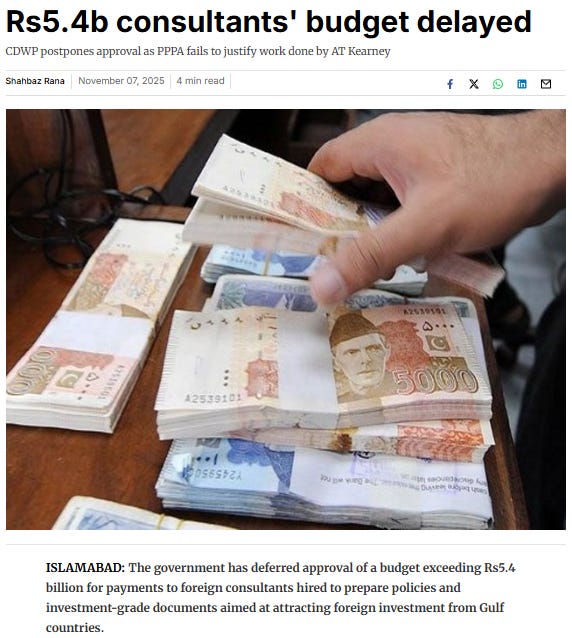
By November of that year, the Central Development Working Party postponed approval for the budget. The executing authority could not justify the work completed or demonstrate any foreign investment brought in as a result. The PKR 3 billion specifically earmarked for feasibility studies had gone entirely unused, because the consultants informed the government they could only provide strategic advice and pitchbooks.
FDI in the July-September period of that fiscal year had dropped 34%, per State Bank of Pakistan data cited in the same report.
The minister who had questioned my credentials moved to a different ministry. The problem he’d declined to engage with on a free weekend had later cost the public PKR 5.43 billion and still remained unsolved.
I would draw three lessons from this whole episode.
The gap between what governments present and what investors need is a structural one.
Governments have data. What they lack is the ability to decompose the investor’s actual decision-making process, map their materials against it, and find exactly where the story breaks down. That’s a problem-solving discipline. It requires holding two different mental models simultaneously and finding where they fail to translate. Years in investment banking help with the vocabulary. They don’t teach you to see the structure underneath it.
I’ve spent my career doing that across sectors with no obvious connective tissue. The skill that let me walk into a room with no energy or finance background and produce a workable diagnostic in a weekend is the same one I’ve used in cross-sectoral reforms, investment climate improvement, impact and pooled fund design, public health, education and industrial policy. The domain changes. The method doesn’t.
Specialist capacity is not a luxury.
The British, who designed the civil service model Pakistan inherited, have largely replaced it with specialists for modern governance problems.
Pakistan is still running on a colonial administrative architecture, one which is fraught with problems it was never built to handle. The PKR 5.43 billion consulting invoice is the recurring cost of that structural deficit, paid each time the system mistakes a credential for a capability.
Leaders don't need all the answers.
They need the judgment to recognize one when it's in front of them, even if it arrives without a tie, without a fee, and two years before the invoice does.